The AI Visibility Checklist for D2C Brands (SEO + AEO)
The full SEO and AEO checklist for D2C brands: collection pages, Product schema, reviews, and how to get named by ChatGPT, Perplexity and Gemini.

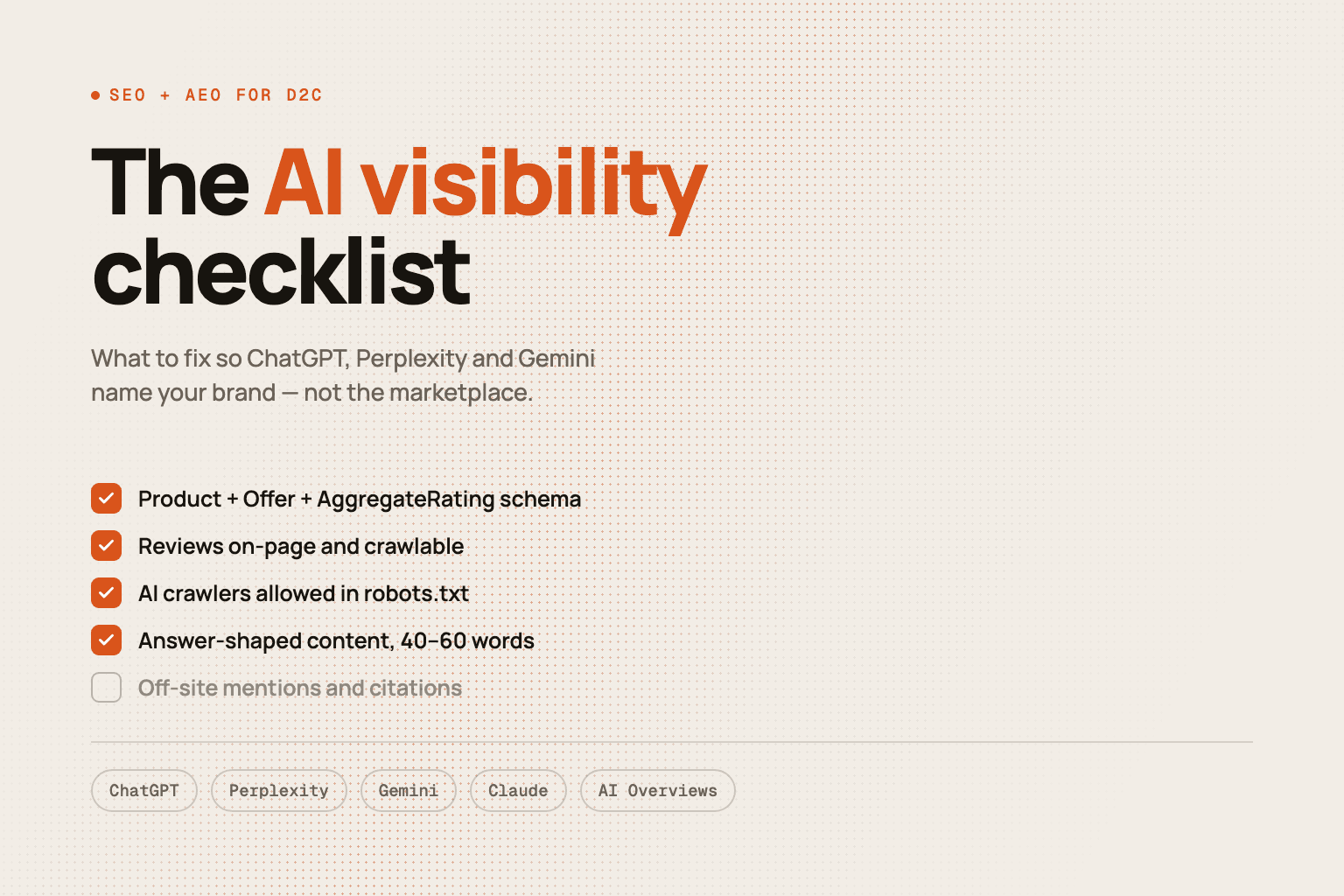
Someone opens ChatGPT and types "best cotton kurta brand under 2000." They get four names. They buy from one of them.
You can rank first on Google for that exact query and not be one of those four names. That is the uncomfortable new fact of D2C search, and it is why this checklist exists — it covers both the SEO that has always worked and the AEO work that has become non-optional since 2024.
This started as an internal class. It is deliberately blunt about what pays and what does not.
The one mental model
D2C SEO is not blog SEO. A content site wants readers. You want buyers at three different temperatures.
|
Temperature |
They search |
Page that wins |
|---|---|---|
|
Hot |
"buy ceramic face serum" or your brand name |
Product page |
|
Warm |
"best serum for oily skin" |
Collection page or comparison post |
|
Cold |
"why is my skin oily after moisturizer" |
Blog or guide |
Most D2C brands over-invest in cold — blogs nobody buys from — and under-invest in warm. Warm is where the money is.
Collection pages usually target the broader commercial keywords and pull more organic traffic than any individual product page. That is the single most exploitable fact in D2C SEO, and almost nobody acts on it.
A working split of effort: 50% collections, 30% product pages, 20% content.
Level-set: authority, keywords, and the funnel math
Domain Rating is a filter, not a scoreboard
Domain Rating (DR) is a third-party estimate — Ahrefs, 0–100 — of how strong your backlink profile is. It is not a Google metric, and chasing it for its own sake is wasted effort.
It answers exactly one useful question: which keywords can we realistically win? A DR 15 brand should not fight a DR 70 marketplace head-on. Pick the queries the giants do not bother with. You can check yours free at Ahrefs' website authority checker.
The three things that matter about keywords
Intent beats volume. "Serum ingredients guide" at 10,000 searches a month is worth less than "vitamin c serum for men" at 800, because the second one buys.
Keyword difficulty lies at the edges. Always eyeball the actual page-one results before trusting a KD score. If page one is all Amazon, Nykaa and Flipkart, walk away regardless of what the number says. If it is other D2C brands your size, that is winnable.
The modifier long tail is where D2C lives. "…for oily skin", "…under 500", "…without fragrance", "…vs [competitor]". Low volume individually, but they stack — and they convert two to five times better than head terms.
The funnel math everyone forgets
Position nine earns roughly 1% of clicks. Position three earns roughly 10%. Moving one existing page from nine to three usually beats publishing five new ones. Before you commission anything new, look at what is already sitting on page one's back half.
What actually lifts D2C revenue, ranked
1. Collection pages treated as landing pages
The default Shopify collection page is a grid with a title on top. The version that ranks has a unique 150–300 word intro that is not boilerplate, an FAQ block, internal links to sibling collections, and filters that produce crawlable URLs for the big sub-intents — /collections/serums/oily-skin rather than a JavaScript filter state that no crawler ever sees.
This is the highest-ROI work in D2C SEO. It is also the least glamorous, which is why it stays available.
2. Reviews, everywhere, structured
Reviews do triple duty. They lift conversion. They are fresh, keyword-rich content that Google reads. And — the part that is new — they are the single strongest signal AI assistants look for before recommending a product.
Two requirements: they must render on your page, not only inside a widget served from the vendor's domain, and they must carry AggregateRating markup.
3. Comparison and alternatives content
"X vs Y" and "best [category] for [use case]" pages rank at medium difficulty, convert at high intent, and are precisely what large language models quote when someone asks for a recommendation.
Write them honestly. Include real competitors, admit real trade-offs. An honest comparison outranks and out-converts a rigged one, and it is the kind of page that earns citations rather than eye-rolls.
4. Technical: speed, internal links, index hygiene
Three fundamentals, in order:
Page speed. D2C sites drown in app scripts. Audit your installed apps quarterly and delete what you are not using.
Internal linking. Every product should sit within three clicks of the homepage, via a category.
Index control. Faceted URLs, ?sort= parameters and out-of-stock pages need canonicalising or noindex, or you end up with 10,000 junk URLs diluting the 100 real ones.
5. Product page depth
Unique descriptions of 200 words or more — never the manufacturer's copy, which every reseller also has. A specs table. Three or more images with real alt text. And answers to the actual pre-purchase questions: shipping, returns, "will this work for X."
Title format: [Product] – [Key Benefit] | [Brand], under 60 characters.
A reality check on timelines
Ranking movement takes about three months. Meaningful organic revenue lands somewhere in months six to nine. Anyone promising faster is selling something.
Once it compounds, though, it is the cheapest traffic you will ever buy — and it makes paid spend more efficient, because you get better landing pages, lower CPCs and larger retargeting pools out of the same work.
AEO: the new 30%
People now ask ChatGPT, Perplexity and Google's AI mode what to buy, and they buy what gets named. The rules overlap with SEO but they are not identical.
How LLMs pick which products to recommend
Structured data is the entry ticket. Missing Product, Offer, GTIN and AggregateRating markup is the most common reason a SKU is skipped entirely in AI answers. This is a days-of-work fix that tends to show up in AI retrieval within weeks — the best effort-to-outcome ratio in this entire document.
Reviews are the validation layer. Assistants actively look for authentic customer feedback before citing a brand. Crawlable, on-site, structured.
Off-site mentions are the trust layer. Press, Reddit threads, "best of" listicles, community mentions. AI engines weight external validation heavily, and a brand that only its own website talks about does not get recommended. Yes, this makes PR an SEO channel again.
Answer-shaped content gets quoted. A direct 40–60 word answer sitting under a question-shaped heading is what gets lifted into AI Overviews. Write the answer first and elaborate afterwards.
Housekeeping
Do not block AI crawlers in robots.txt — GPTBot, OAI-SearchBot, ClaudeBot, PerplexityBot and Google-Extended. Add an llms.txt.
Then test it live. Ask ChatGPT and Perplexity for recommendations in your category, your city and your price band, and note who gets named. Do it monthly. That is your AEO rank tracker, and it costs nothing.
The checklist
Foundation, week one
- Search Console verified, sitemap submitted, GA4 tracking organic revenue rather than sessions
robots.txtclean, AI crawlers allowed,llms.txtlive- Core Web Vitals passing on mobile — test three money pages, not the homepage
- Faceted, parameter and out-of-stock URLs canonicalised or noindexed
Collections, weeks one to four — highest ROI
- Unique intro copy and an FAQ on every major collection
- One collection per real search intent, including use-case subcollections
- Interlinked siblings, breadcrumbs everywhere
- Title format:
[Category] for [Use Case] | [Brand]
Product pages, ongoing
Product+Offer+AggregateRatingschema on every SKU, with GTIN, brand and availability — validate at Google's Rich Results Test- Unique 200+ word descriptions, a specs table, three or more images at 800px or wider with descriptive alt text and filenames
- Reviews rendered on-page and crawlable
- Related products and a link back to the category
Content and AEO, month two onward
- Two or three honest comparison or "best for" pages in your category
- 40–60 word direct answers under question-shaped H2s, FAQ schema where the questions are genuine
- Monthly: ask ChatGPT and Perplexity for recommendations in your category, log who gets named
- At least one off-site mention a month — press, listicle, or community
Measure, fifteen minutes weekly
- Search Console impressions and average position on money pages. Impressions lead clicks by weeks, so they are your early warning
- Organic revenue, not organic traffic
- Your AI mentions log
Five mistakes worth naming
- Blog-first strategy. Forty posts and zero optimised collections. Backwards.
- Manufacturer descriptions. Duplicate content across every reseller. Google picks one winner and it is rarely you.
- Killing pages seasonally. Deleting or 404-ing seasonal collections every year instead of keeping the URL alive and re-dressing it.
- App bloat. Thirty Shopify apps and a twelve-second load. Speed is both a ranking factor and a conversion factor.
- Ignoring the AI channel because it is small. It is small the way mobile was small in 2010. Schema and reviews now compound into citations later.
Running the checklist with claude-seo
Everything above is checkable, and mostly fixable, with the open-source claude-seo skill — MIT licensed, runs inside Claude Code.
Install with /plugin marketplace add AgriciDaniel/claude-seo, then /plugin install claude-seo@agricidaniel-claude-seo, then /seo setup. Run /seo doctor to verify.
|
What you are checking |
Command |
Then fix by |
|---|---|---|
|
Everything at once — up to 500 pages, ~15 specialist agents, health score |
|
Working the prioritised findings list |
|
One money page, deep |
|
Rewriting title, meta and headings from the findings |
|
Technical SEO across nine categories |
|
Pasting the structured output straight into a dev ticket |
|
E-E-A-T and content quality, trust-weighted |
|
Adding author entities, first-hand evidence, sources |
|
Product, Offer and AggregateRating schema |
|
Pasting the generated JSON-LD into your theme |
|
E-commerce specifics and Shopping visibility |
|
Its product checklist, which maps to the section above |
|
AEO and AI-search readiness |
|
Its per-platform recommendations |
|
Images — alt text, formats, weight, CLS |
|
|
|
Real Google data — GSC, indexation, field CWV |
|
Feeding the weekly review above |
|
Keyword clusters, before writing anything |
|
One page per cluster, not per keyword |
|
"Why doesn't this page rank?" |
|
Fixing the page-type mismatch it identifies |
|
Regression insurance around theme changes |
|
|
E-E-A-T in sixty seconds
Google's rater guidelines weight Trust highest, then Expertise and Authoritativeness, then Experience. For D2C that translates to:
- Experience — real product photos, founder story, "we tested this" content, UGC
- Expertise — who formulated or designed it, credentials on an About page that is not empty
- Authoritativeness — press, retailer stocking, inclusion in "best of" lists
- Trust — visible contact details, a returns policy, HTTPS, real reviews including the imperfect ones, accurate claims
Apply Google's own three questions to any page. Who made this? How was it made? Why does this page exist — to help, or to rank? A weak answer to any of them is your fix list.
A workable cadence
- Once:
/seo audit, fix the P0s, then/seo drift baselineyour top ten URLs - Per new page:
/seo clusterbefore writing,/seo pageand/seo schemabefore publishing - Monthly:
/seo geoplus the manual ChatGPT and Perplexity taste test - After every theme or app change:
/seo drift compare
If you would rather the keyword research, clustering and publishing run on their own, that is what Indexly does — it scores which keywords you can realistically win, then writes and publishes to your CMS. The checklist above still applies either way.
Sources
Frequently Asked Questions
What is AEO, and how is it different from SEO?
Answer Engine Optimisation is the work of getting your brand named inside AI-generated answers on ChatGPT, Perplexity, Gemini and Google's AI Overviews. SEO competes for a ranked list of links; AEO competes to be cited in a single synthesised answer. The signals overlap, but structured data and third-party validation matter far more for AEO.
Why does my brand rank on Google but never get mentioned by ChatGPT?
Almost always one of three gaps: missing Product, Offer and AggregateRating schema, so the SKU cannot be parsed; reviews that live inside a widget on the vendor's domain rather than on your crawlable page; or no off-site mentions. AI engines weight external validation heavily and rarely recommend a brand only its own site discusses.
What schema do D2C product pages need for AI visibility?
Product, Offer and AggregateRating at minimum, with GTIN, brand and availability populated. Missing this markup is the single most common reason a SKU is skipped entirely in AI answers. It is a few days of work, validates free at Google's Rich Results Test, and typically shows up in AI retrieval within weeks.
Should D2C brands prioritise collection pages or product pages?
Collection pages. They target the broader commercial keywords and usually pull more organic traffic than any individual product page, yet most brands leave them as an unedited grid with a title. A workable split of effort is 50% collections, 30% product pages, 20% content.
How long does D2C SEO take to produce revenue?
Expect ranking movement at around three months and meaningful organic revenue between months six and nine. Anyone promising faster is selling something. Once it compounds it becomes the cheapest traffic you will buy, and it lowers paid CPCs by improving landing pages and retargeting pools.
How can I track AI visibility for free?
Ask ChatGPT and Perplexity for recommendations in your category, your city and your price band, then log which brands get named. Repeat monthly and track the change. It is manual, but it measures the thing that actually matters, and it costs nothing.