7 Best Autoblogger Tools for SEO in 2026
The 7 best autoblogger tools ranked by SEO workflow fit — from competitive keyword discovery to auto-publishing, matched to your team size and budget.


Most SEO teams are publishing 2 to 4 blog posts per month manually. Competitors using autoblogger workflows are shipping 30 or more. That gap translates directly into lost keyword rankings, slower topical authority, and a content bottleneck that hiring one more writer will not fix.
The math is straightforward. Every month you publish fewer articles than your competitors, they compound their indexed pages, internal link equity, and topical coverage. No amount of "quality over quantity" positioning closes a 10x output gap when both sides are optimizing for search.
This article is a decision guide, not a feature list. Each tool below maps to a specific workflow type, SEO maturity level, and budget. Read down the list and stop at the profile that matches your operation.
What Makes an Autoblogger Tool Worth Using for SEO in 2026
An autoblogger is a software system that automates some or all of the blog content pipeline, from keyword identification and research through writing, formatting, and publishing to a live CMS.
Not all tools automate the same stages, and that distinction determines whether a tool accelerates your SEO or quietly produces content that Google ignores.
Keyword Intelligence vs. Keyword Input: Who Does the Research?
The criterion: Does the tool find ranking opportunities on its own, or does it wait for you to supply keywords?
Tools that require keyword input shift the hardest research work back onto you. Cheap autobloggers accept any keyword and produce content without assessing search volume, difficulty, or competitive gaps. You end up with polished articles targeting terms your domain cannot rank for yet.
Content Originality: Why Generic AI Output Kills Rankings
The criterion: Does the tool produce content differentiated by data, structure, or insight, or does it recombine existing SERP content?
Generic AI output, what practitioners call AI slop, tends to mirror the top-ranking pages almost structurally. Google has explicitly flagged scaled content that adds no original value. Tools that embed original data points, custom infographics, or brand-specific framing produce content with a legitimate ranking signal. Verified user feedback on tools like Autoblogging.ai specifically highlights semantic SEO best practices and EEAT-friendly structure as distinguishing factors over raw output speed.
CMS Publishing Integration and Workflow Fit
The criterion: Can the tool publish directly to your CMS, or does it stop at a Word doc export?
A tool that stops at content generation adds a manual publishing step for every article. At 30 articles per month, that step becomes its own bottleneck.
Scalability: From 4 Posts a Month to 40
The criterion: Does the tool's architecture hold up at volume, or does quality degrade when you increase output?
Some tools perform well at five articles per week and produce inconsistent structure at twenty. Blogging SEO best practices require consistent heading hierarchy, internal linking logic, and metadata. Scalable automated blogging tools enforce those standards programmatically.
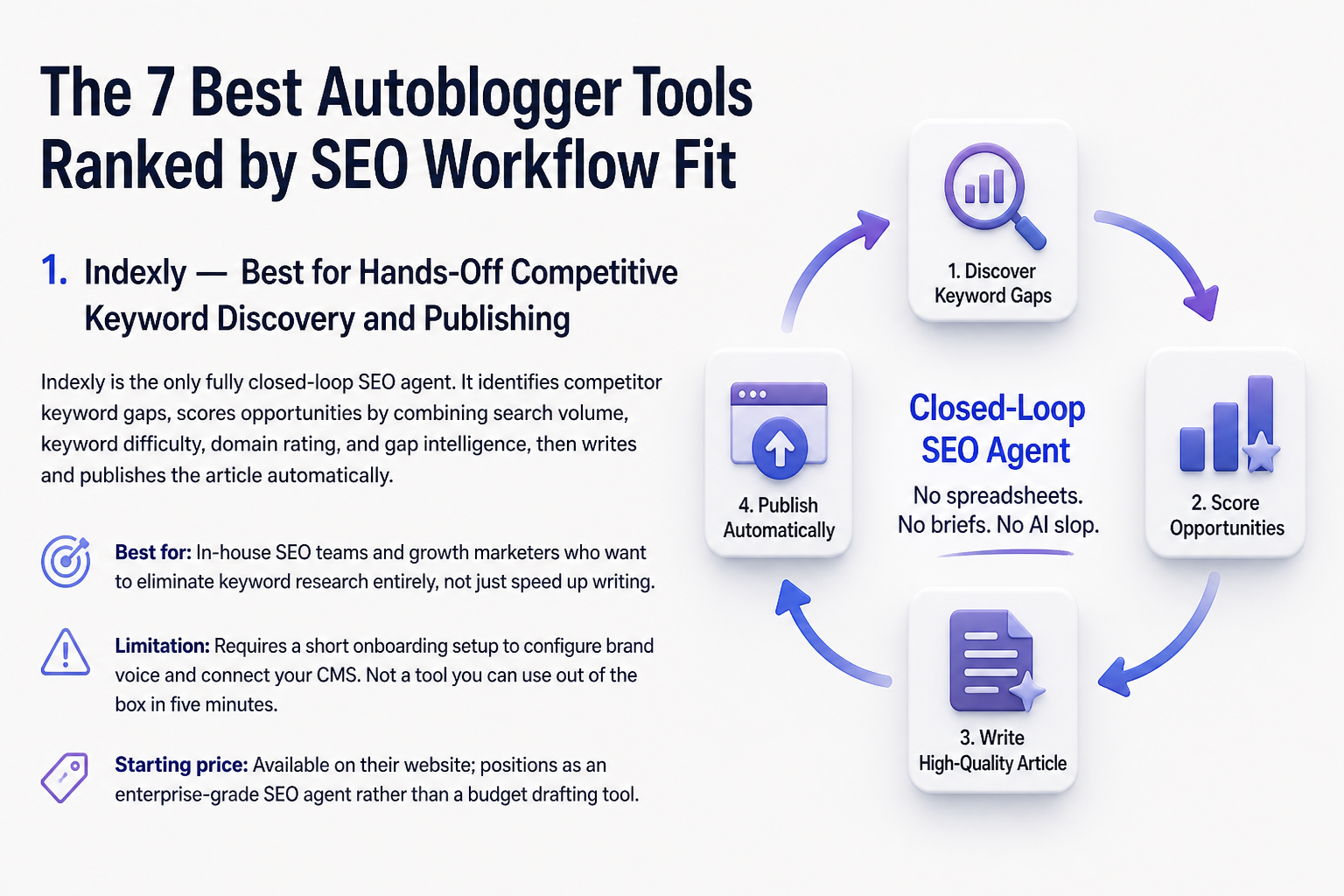
The 7 Best Autoblogger Tools Ranked by SEO Workflow Fit
1. Indexly — Best for Hands-Off Competitive Keyword Discovery and Publishing
Indexly is the only fully closed-loop SEO agent in this list. It identifies competitor keyword gaps, scores opportunities by combining search volume, keyword difficulty, domain rating, and gap intelligence, then writes and publishes the article automatically.
Indexly is the only tool here that combines competitor keyword gap analysis with AI article generation and direct CMS publishing in a single agent loop, meaning you never touch a spreadsheet or a brief. If your bottleneck is identifying what to write, not just writing faster, that distinction matters. Articles include original data and infographics, and output matches brand voice through a calibration setup.
Best for: In-house SEO teams and growth marketers who want to eliminate keyword research entirely, not just speed up writing.
Limitation: Requires a short onboarding setup to configure brand voice and connect your CMS. Not a tool you can use out of the box in five minutes.
Starting price: Free plan available; paid plans scale by output volume.
2. Autoblogging.ai — Best for Semantic SEO and Topical Authority Builds
Autoblogging.ai positions itself as an AI article writer focused on semantic relevance and search ranking improvement.
Users documented in verified feedback consistently highlight that the tool combines AI writing automation with semantic SEO best practices, specifically praising its ability to create niche-specific content with EEAT-friendly structure. It supports topic clustering, which makes it useful for building pillar and supporting article architectures.
Best for: Content marketers who have their keyword strategy defined and need high-volume semantic content execution.
Limitation: Keyword research is not built in. You supply the topics; the tool handles the writing.
Starting price: Entry plans begin around $19 per month.
3. Outrank — Best for Recurring SEO Article Schedules Without a Writer
Outrank's core pitch is direct: you choose your keywords and receive research-based, SEO-optimized articles on a recurring schedule. The positioning is explicitly built around delivering 30 SEO articles per month while you focus on your business.
The tool handles research, drafting, and scheduling automatically once the initial keyword set is configured.
Best for: Small business owners and lean marketing teams who need consistent SEO publishing without managing a writer.
Limitation: Competitive intelligence is limited. The tool executes on your keyword input rather than discovering gaps you have not already identified.
Starting price: Plans typically start around $49 per month depending on article volume.
4. Journalist AI — Best for Multi-Channel Content Syndication
Journalist AI is built for teams publishing content across multiple channels simultaneously. It generates blog articles and distributes them across social, newsletters, and partner sites from a single workflow.
The content syndication SEO value here is real. One production run populates multiple distribution channels, reducing the per-channel cost of content creation significantly.
Best for: Content agencies and marketing managers running multi-channel campaigns where blog content feeds downstream channels.
Limitation: The depth of SEO optimization per article is lower than tools focused exclusively on search. Syndication breadth trades off against ranking-focused depth.
Starting price: Plans start around $39 per month.
5. SEOWriting.ai — Best Budget AI Blog Generator for Solo Creators
SEOWriting.ai is a straightforward AI blog generator targeting solo content creators and freelancers who need fast, affordable SEO article drafts.
It supports one-click blog post generation with basic on-page SEO signals, including meta descriptions, heading structures, and keyword placement. The output requires editing but delivers a usable first draft quickly.
Best for: Solo growth marketers and niche bloggers who need to increase publishing frequency without a large budget.
Limitation: No competitive analysis, no CMS auto-publishing in base plans, and the output requires human editing to avoid thin content issues.
Starting price: Free tier available; paid plans from around $9 per month.
6. Byword — Best for High-Volume Programmatic SEO Pages
Byword is built for programmatic SEO at scale. It generates articles from templates and data inputs, making it well-suited for producing hundreds of location pages, product category articles, or comparison pages.
The seo article writing use case here is specifically template-driven volume, not editorial content.
Best for: E-commerce teams, SaaS companies with large feature sets, and SEO agencies running programmatic campaigns.
Limitation: Editorial quality per article is intentionally secondary to volume. Byword is the wrong tool for thought leadership or competitive informational content.
Starting price: Plans start around $25 per month.
7. WordHero — Best Entry-Level Blog Post Generator for Non-Technical Marketers
WordHero is an entry-level AI blog writer designed for marketers with no SEO background. It produces structured blog post drafts from a title and a few prompt inputs.
The interface is simple enough that non-technical users can produce publish-ready drafts without understanding SEO architecture.
Best for: Small business owners and marketing generalists who are just beginning to invest in blog content.
Limitation: No SEO intelligence layer, no keyword research, no CMS integration. This is a drafting assistant, not an automated blogging system.
Starting price: Lifetime deals available; monthly plans start around $49.
How to Match Your Autoblogger Setup to Your Content Strategy
Choosing a tool based on features alone produces the wrong answer. Your content strategy bottleneck determines which tool actually moves the needle.
Profile 1: In-House SEO Team Needing Competitive Intelligence + Publishing
Bottleneck: The team knows content volume matters but spends most of its time in spreadsheets figuring out what to write next.
Primary tool: Indexly. It removes the research and briefing steps entirely and publishes directly to your CMS.
Backup option: Autoblogging.ai for semantic content fills on already-identified topic clusters.
Expected output: Teams typically shift from 4 to 6 manual posts per month to 20 or more published articles with the same headcount.
Profile 2: Content Agency Managing Multiple Client Blogs
Bottleneck: Delivery speed across multiple client accounts with inconsistent writer availability.
Primary tool: Journalist AI for multi-channel syndication efficiency.
Backup option: Autoblogging.ai for client accounts requiring topical authority depth.
Expected output: One content production workflow covering blog, social, and newsletter per client, reducing per-client delivery time by roughly half.
Profile 3: Solo Marketer Automating a Niche Blog on a Tight Budget
Bottleneck: No time to write consistently; limited budget for content tools or freelancers.
Primary tool: SEOWriting.ai for affordable draft generation.
Backup option: Byword if the site has a programmatic SEO component.
Expected output: 8 to 12 publishable drafts per month at under $20 in tool cost, with one to two hours of editing per week.
What Autoblogger Tools Still Cannot Do (and Where You Stay in the Loop)
Automation handles volume. It does not handle judgment. These three gaps require human intervention regardless of which tool you choose.
Brand Voice Calibration Requires Human Input at Setup
Every tool in this list either accepts a brand voice brief or learns from existing content samples. That input has to come from a human who understands how the brand communicates. Skip this step and the tool produces technically correct content that reads like it came from a competitor. The SEO content writing quality drops, and readers notice before Google does.
Original Data, Studies, and Expert Quotes Still Need a Human Source
AI content tools recombine existing published information. They cannot conduct interviews, run original surveys, or access unpublished research. Content that earns links and topical authority almost always contains at least one element a competitor cannot replicate. That element requires a human to source it. Relying on AI slop content without original signals is a documented risk under Google's scaled content guidance.
Content Pruning and Topical Authority Audits Remain Manual
Autobloggers produce content forward. They do not audit what already exists on your site for cannibalization, thin pages, or outdated information. A site publishing 30 articles per month without a quarterly pruning review will accumulate content that dilutes authority rather than building it. The seo content optimization work of deciding what to keep, merge, or remove stays with a human SEO editor.
Autoblogger Feature Comparison: A Quick-Reference Table for SEO Teams
Use this table to validate your tool choice before committing to a trial. If you need help matching a tool to your workflow, the profiles section above gives specific recommendations by team type.
|
Tool Name |
Best For |
Keyword Research Built-In |
Auto-Publish to CMS |
Starting Price |
Originality Signal |
|---|---|---|---|---|---|
|
Indexly |
Competitive intelligence + publishing |
Yes |
Yes |
Free plan available |
Original data + infographics |
|
Autoblogging.ai |
Semantic SEO + topical authority |
No |
Yes |
~$19/mo |
Semantic structure |
|
Outrank |
Recurring article schedules |
No |
Yes |
~$49/mo |
Research-based drafts |
|
Journalist AI |
Multi-channel syndication |
No |
Yes |
~$39/mo |
Multi-format output |
|
SEOWriting.ai |
Budget solo blogging |
No |
Paid plans only |
~$9/mo |
Basic on-page SEO |
|
Byword |
Programmatic SEO pages |
No |
Yes |
~$25/mo |
Template-based volume |
|
WordHero |
Non-technical marketers |
No |
No |
~$49/mo |
Prompt-driven drafts |
Conclusion
Your decision comes down to where your production breaks down. If the bottleneck is knowing what to write, meaning you lose time to keyword research, competitor analysis, and briefing, then intelligence-first tools are the right layer to automate first. If the bottleneck is writing speed and you already have a keyword strategy, tools like Autoblogging.ai or SEOWriting.ai close that gap faster. If you are managing content delivery across multiple client accounts, Journalist AI's syndication architecture solves the right problem.
In 2026, the competitive gap between teams using autoblogger workflows and those publishing manually is widening every quarter. The question is not whether to automate content production. It is which layer to automate first.
See how Indexly identifies your competitors' best-ranking keywords and turns them into published articles automatically, no brief, no writer, no spreadsheet.
Frequently Asked Questions
What is an autoblogger and how does it work for SEO?
An autoblogger is a software tool that automates part or all of the blog publishing pipeline, from keyword research and content writing through CMS publishing. For SEO, it works by generating optimized articles at scale, targeting keyword opportunities faster than a manual writing team can, which compounds indexed page count and topical authority over time.
Are autoblogger tools safe to use without getting penalized by Google?
Google's concern is with scaled content that adds no original value, not with automation itself. Tools that produce generic, recombined content at volume create real ranking risk. Tools that generate content with original data, strong semantic structure, and brand-specific framing align with Google's quality guidelines. The tool you choose and the editorial review process you apply to its output determine your risk level.
Which autoblogger tool is best for a small team with no dedicated SEO staff?
Indexly works well here because it handles keyword research and publishing automatically, removing the need for SEO expertise to operate the pipeline. SEOWriting.ai is the budget alternative if the team has some capacity to select keywords manually.
Can autoblogger tools replace a content agency or freelance writer?
For repeatable SEO content at scale, they significantly reduce dependence on external writers. They do not replace agency-level strategy, original research, or creative campaigns. Most teams use them to handle the high-volume informational content layer while reserving human writers for flagship pieces.
How many blog posts per month can a typical autoblogger tool produce?
Output depends on plan tier and the tool's architecture. Entry-level tools can produce 10 to 20 articles per month. Tools like Outrank position explicitly around 30 articles per month as a standard delivery volume. Enterprise configurations can produce well above that.
What is the difference between an autoblogger and a standard AI writing tool?
A standard AI writing tool generates text on demand when a human provides a prompt. An autoblogger runs the entire pipeline autonomously: it identifies topics, researches content, writes articles, and publishes them on a schedule without requiring a human to trigger each step. The automation depth is what separates the two categories.