7 Best Local SEO Services for Multi-Location Brands in 2026
Comparing the 7 best local SEO services for multi-location brands in 2026. See pricing, strengths, and which agencies actually scale across locations.


Managing local SEO across five, ten, or fifty locations is a different problem than ranking a single storefront. Every location needs its own citation audit, Google Business Profile, keyword targeting, and content. Most agencies were built for single-location clients and will charge you per-location fees that compound into budget waste before you see a single ranking gain.
The structural challenge is real: skipping competitor research at the location level, ignoring visual content as a ranking signal, and treating every market with one blanket strategy are among the most costly mistakes multi-location brands make. Local SEO is not one-size-fits-all. What moves the needle in Houston may not be what a Denver or Charlotte location needs.
This article evaluates seven local SEO services specifically on their ability to handle multi-location complexity. Each entry covers who it is built for, where it performs at scale, its honest limitations, and pricing tier so you can build a shortlist before you ever get on a sales call.
What Makes a Local SEO Service Actually Work at Scale
Most buyers compare local SEO services on price alone and miss the five structural factors that determine whether an agency can actually execute across locations.
|
Criteria |
Why It Matters at Scale |
|---|---|
|
Citation consistency |
Inconsistent NAP data across locations destroys local ranking signals and is nearly impossible to clean manually |
|
GBP management depth |
Each location needs individual profile optimization, review response, and category management |
|
Location-level keyword targeting |
A single keyword strategy shared across markets misses local intent and competitor gaps specific to each city |
|
Reporting granularity |
Aggregated reports hide underperforming locations. You need per-location rank and traffic data |
|
Content production capacity |
Location pages, service area content, and blog posts must be produced at volume without quality decay |
Citation Consistency Across Every Location
Every location operates as its own local entity in Google's eyes. A single name, address, or phone number inconsistency across directories can suppress an individual location's map pack visibility without affecting others. At ten-plus locations, manual citation management is not sustainable.
Managing local SEO across multiple locations requires precise data handling, much like how Attenditai ensures accurate attendance verification through features like geofencing and QR code scanning, both demanding meticulous attention to detail.
Google Business Profile Management at Volume
GBP optimization is not a one-time setup. Review responses, post cadence, photo uploads, and category accuracy are ongoing signals. An agency that treats GBP management as a launch task rather than a recurring function will see location performance erode within months.
Location-Level Keyword Targeting vs. One-Size-Fits-All
Local search intent changes by market. Competitor sets differ by zip code. An agency running the same keyword map across all locations is leaving significant ranking opportunity on the table. The best local SEO agencies build individual keyword strategies per location based on actual competitor gap data.
Reporting That Shows Per-Location Performance
Aggregate reporting is a red flag for multi-location brands. You need to see which locations are gaining rank, which are stagnant, and which are under competitive attack. Without per-location visibility, budget allocation decisions are guesses.
How We Evaluated These Local SEO Services
Services on this list were scored across four criteria:
- Multi-location capability: dedicated workflows for managing three or more locations simultaneously
- Transparent local SEO pricing: published or clearly disclosed pricing structures without requiring a discovery call
- Verified multi-location results: published case studies or client reports showing results across three or more locations
- Dedicated account management: a named contact responsible for strategy, not just a support ticket queue
Services that scored well on fewer than three of these criteria were excluded from the list.
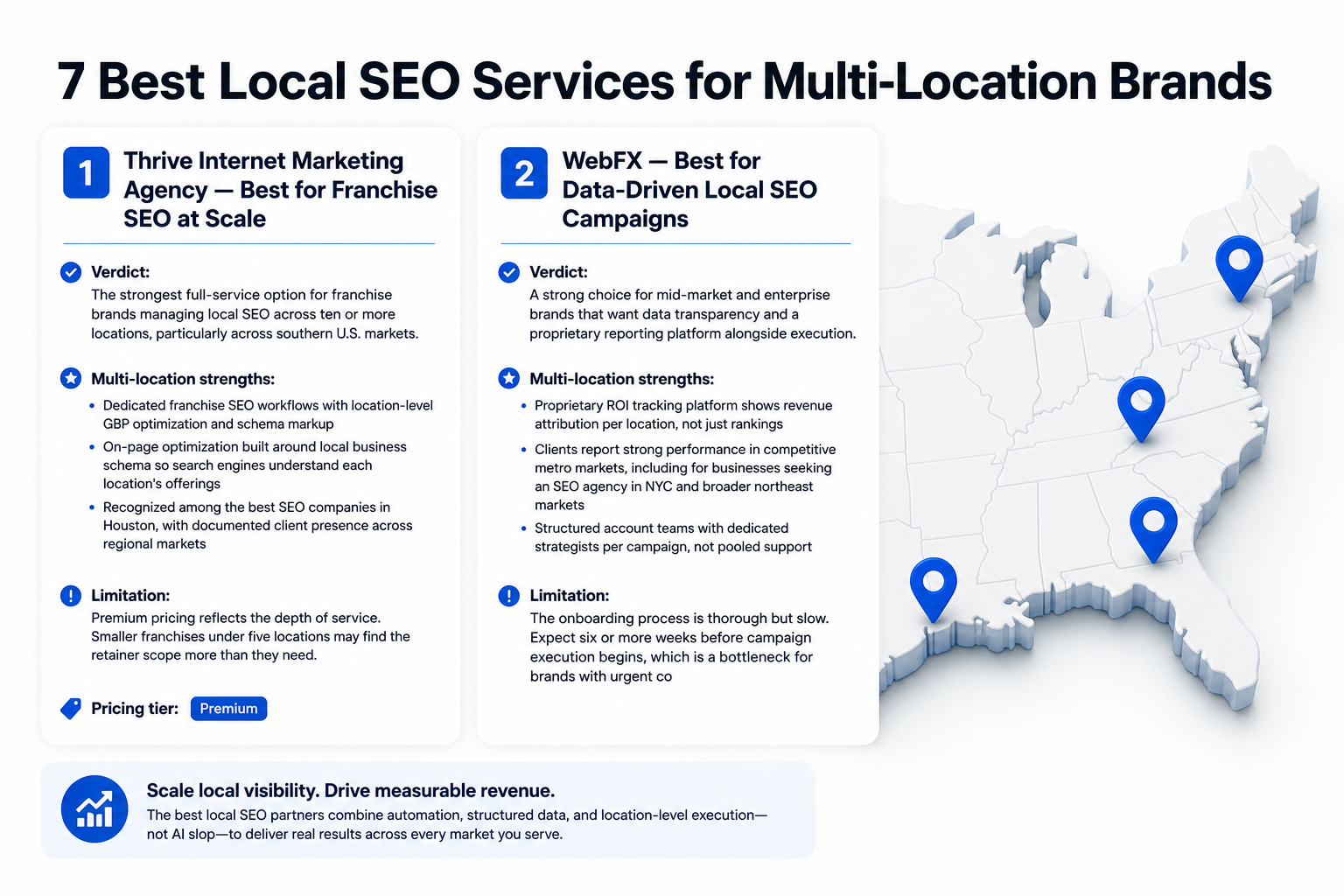
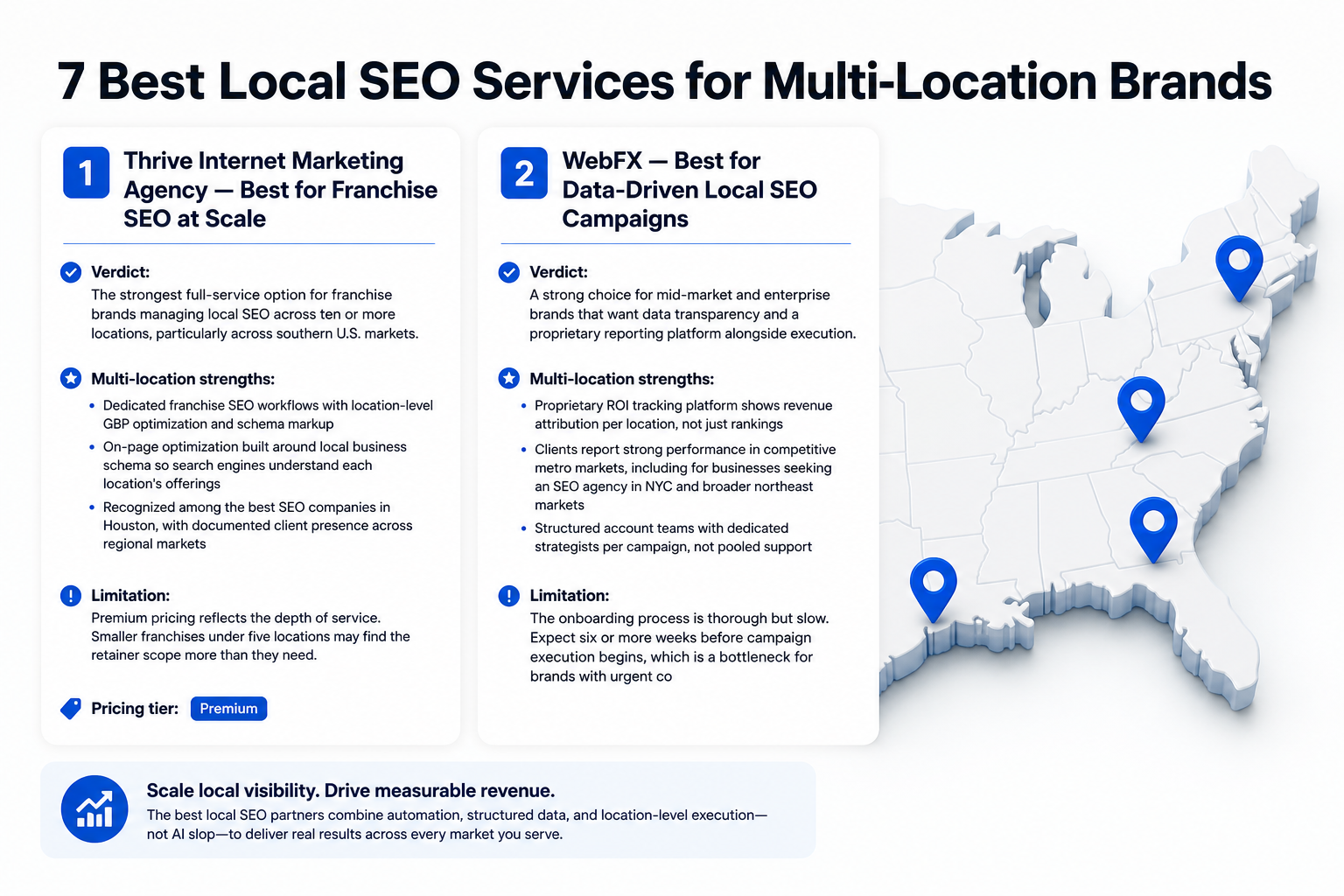
7 Best Local SEO Services for Multi-Location Brands
1. Thrive Internet Marketing Agency — Best for Franchise SEO at Scale
Verdict: The strongest full-service option for franchise brands managing local SEO across ten or more locations, particularly across southern U.S. markets.
Multi-location strengths:
- Dedicated franchise SEO workflows with location-level GBP optimization and schema markup
- On-page optimization built around local business schema so search engines understand each location's offerings
- Recognized among the best SEO companies in Houston, with documented client presence across regional markets
Limitation: Premium pricing reflects the depth of service. Smaller franchises under five locations may find the retainer scope more than they need.
Pricing tier: Premium
2. WebFX — Best for Data-Driven Local SEO Campaigns
Verdict: A strong choice for mid-market and enterprise brands that want data transparency and a proprietary reporting platform alongside execution.
Multi-location strengths:
- Proprietary ROI tracking platform shows revenue attribution per location, not just rankings
- Clients report strong performance in competitive metro markets, including for businesses seeking an SEO agency in NYC and broader northeast markets
- Structured account teams with dedicated strategists per campaign, not pooled support
Limitation: The onboarding process is thorough but slow. Expect six or more weeks before campaign execution begins, which is a bottleneck for brands with urgent competitive pressure.
Pricing tier: Mid-Market to Premium
3. Victorious — Best for Transparent Local SEO Pricing
Verdict: The best option for brands that need predictable, published pricing before committing to a contract, with strong performance in tech-heavy metros.
Multi-location strengths:
- Published pricing tiers make budget planning straightforward without requiring a sales call
- Clients seeking SEO agencies in Austin and the best SEO companies in Austin report strong local keyword performance
- Campaign structure separates technical SEO, content, and link building into defined deliverables
Limitation: Content production volume at scale can require add-on packages, which increases the effective retainer cost for brands needing location pages at volume.
Pricing tier: Mid-Market
4. SEO Brand — Best for Multi-Channel Local Authority Building
Verdict: Suited for brands that need local SEO integrated with paid search, social, and reputation management under one strategy.
Multi-location strengths:
- Combines organic local SEO with seo ads and paid local strategies to capture intent at multiple funnel stages
- Reputation management workflows built into local SEO campaigns, covering review acquisition and response
- Operates across international and domestic markets for brands with locations outside the U.S.
Limitation: The multi-channel approach adds value but also adds complexity. Brands that want pure organic local SEO execution may find the integrated model over-engineered for their needs.
Pricing tier: Mid-Market to Premium
5. Hibu — Best for Small Business Multi-Location Packages
Verdict: The most accessible entry point for small business owners managing two to five locations who need bundled local SEO without enterprise complexity.
Multi-location strengths:
- Packaged local SEO services for small business with GBP management, citation building, and basic reporting included
- Faster onboarding than most full-service agencies, typically under two weeks
- Pricing is structured for local SEO for small business budgets, not scaled agency retainers
Limitation: Reporting depth is limited compared to enterprise-tier agencies. Per-location rank tracking and custom attribution are not standard inclusions.
Pricing tier: Budget
6. Straight North — Best for Local Lead Generation Campaigns
Verdict: A focused agency for B2B and service businesses that measure SEO success in phone calls and form fills, not just organic traffic.
Multi-location strengths:
- Campaign architecture built around lead tracking per location, not aggregate traffic
- Recognized among the best SEO companies in Dallas and operates as a go-to Dallas SEO agency for service-area businesses
- Transparent reporting links keyword rankings directly to conversion events at the location level
Limitation: Content production is not a core strength. Brands needing location pages at volume will likely need to supplement with additional content resources.
Pricing tier: Mid-Market
7. Indexly — Best for Automated Keyword Research and Content at Scale
Verdict: The only option on this list that removes the content production bottleneck entirely rather than charging per-location content fees.
Multi-location strengths:
- Automated competitor gap analysis identifies keyword opportunities per location without manual research
- Opportunity scoring combines search volume, keyword difficulty, and domain rating to prioritize content production
- Publishes directly to ten-plus CMS platforms including WordPress, Webflow, and Shopify, eliminating publishing workflow friction
- Topic clustering builds topical authority across pillar and supporting article structures per location
Limitation: Indexly is software-led rather than service-led. Brands that need a hands-on human account team for strategy calls and client services should pair it with a strategic consultant.
Where most agencies still rely on manual keyword research and human writers to produce location pages, Indexly's AI SEO agent automatically identifies competitor keywords, scores opportunity gaps per location, writes SEO-optimized articles with original data, and publishes directly to your CMS. This makes Indexly the only option on this list that removes the content bottleneck entirely rather than charging per-location content fees.
Pricing tier: Free plan available; paid plans scale by output volume
Local SEO Pricing: What Multi-Location Brands Actually Pay
Expecting single-location pricing to scale linearly is the fastest way to blow a local SEO budget. Most agencies charge per location, which means a ten-location brand can hit enterprise-tier costs without enterprise-tier reporting or strategy.
Per-Location Retainer vs. Enterprise Campaign Pricing
Per-location retainers work well for brands with three to six locations and distinct local markets. Enterprise campaign pricing, charged as a single flat retainer covering all locations, becomes more cost-effective at ten or more locations because the fixed overhead is amortized across the portfolio.
AI tooling is beginning to reduce agency overhead in 2026, and some agencies are passing cost savings into content production and reporting. This is worth asking about directly when evaluating local SEO packages.
|
Tier |
Locations |
Monthly Range |
Typical Inclusions |
|---|---|---|---|
|
Small |
1 to 3 |
$500 to $1,500/location |
GBP management, citations, basic on-page, monthly report |
|
Mid-Market |
4 to 15 |
$1,000 to $3,000/location or flat $8,000 to $20,000 |
Above plus content, link building, per-location rank tracking |
|
Enterprise |
16+ |
$15,000 to $50,000+ flat |
Full content production, technical audits, custom dashboards, dedicated team |
What's Included in a Typical Local SEO Package
Standard local SEO packages at every tier include GBP optimization, citation management, and on-page optimization. Mid-market and enterprise tiers add content production, technical SEO audits, link building, and review management. Per-location reporting is not always standard. Confirm it explicitly before signing.
How to Choose a Local SEO Service Without Wasting 3 Months on the Wrong Agency
The wrong agency at ten locations is not just a bad vendor relationship. It is ten sets of stagnant rankings, ten GBP profiles undermanaged, and ten markets where your competitors are executing better while you wait for campaign revisions.
5 Questions to Ask Before Signing Any Local SEO Contract
- How many multi-location clients are you currently managing, and what is the average location count? This reveals whether multi-location work is their core capability or an upsell from single-location practice.
- How do you build keyword strategies differently for each location, not just each service? Agencies without a location-level keyword process will apply one strategy across all markets and miss local competitor gaps entirely.
- What does per-location reporting look like, and how often do we see it? The answer tells you whether they can actually diagnose underperforming locations or only report aggregate growth.
- What is your content production capacity per month, and how does that scale with location count? Content is the most common scaling constraint. Know the ceiling before you sign.
- Can you show a case study for a brand with five or more locations in a competitive vertical? Conditional results across a comparable client set are far more useful than generic rank improvement claims.
Red Flags That Signal an Agency Isn't Built for Multi-Location
- They present a single keyword strategy covering all locations with no mention of local competitor research
- Reporting samples show only aggregate traffic, with no location-level rank breakdowns
- The contract has no content production volume commitment, only a vague "content as needed" clause
Conclusion
The agency you choose should match two variables: your location count and whether you have internal content capacity. A franchise with twenty locations and no content team will exhaust a mid-market agency's production capacity within a quarter and stall.
If you have neither the budget for a full-service enterprise agency nor an internal content team, the agencies on this list that charge per-location content fees will become expensive fast. The SEO landscape in 2026 is changing fast, with AI-driven search results shifting how local visibility is won. The brands pulling ahead are the ones that stopped doing keyword research and content production manually and built systems that scale with location count, not against it.
See how Indexly automates local keyword research and content publishing across every location, without adding headcount.
Frequently Asked Questions
What is local SEO marketing and how does it differ from standard SEO?
Local SEO marketing optimizes a business's visibility for location-specific searches, primarily in Google's map pack and local organic results. Standard SEO targets broad keyword rankings without a geographic component. Local SEO adds Google Business Profile management, local citations, location-level content, and proximity signals that standard campaigns do not address.
How much do local SEO services cost for a business with multiple locations?
Costs depend on location count and service depth. Small businesses with one to three locations typically pay $500 to $1,500 per location per month. Mid-market brands managing four to fifteen locations often see flat retainers between $8,000 and $20,000 monthly. Enterprise brands with sixteen or more locations can expect $15,000 to $50,000 or more per month for full-service management.
Which local SEO service is best for small businesses with limited budgets?
Hibu offers the most accessible pricing structure for small businesses managing two to five locations. For brands that need content production at scale without agency fees, Indexly provides automated keyword research and content publishing with a free plan to start. The best fit depends on whether the priority is hands-on service or content volume.
How long does it take to see results from a local SEO campaign?
Most multi-location brands see measurable rank improvements in competitive markets within three to six months of consistent execution. Citation cleanup and GBP optimizations can show impact within four to eight weeks. Content-driven ranking gains, particularly for location pages, typically take three to five months to stabilize.
Can I manage local SEO in-house or do I need an agency?
In-house management is viable for brands with one to three locations and a dedicated SEO resource. At five or more locations, the manual workload for citations, GBP management, keyword research, and content production creates a bottleneck that either requires additional headcount or an agency with multi-location infrastructure. The decision comes down to build versus buy on internal SEO capacity.