G-Stack Explained: Components, Uses & SEO Benefits
G-Stack is Garry Tan's Claude Code skill collection with 89.7K stars. Learn its components, use cases, and how to pair it with AI SEO for organic growth.


Garry Tan's g-stack hit 89.7K GitHub stars in under two months, with more than 10K of those arriving in the first 48 hours. The most telling detail is this: the repo was built largely by Claude Opus 4.7, the same AI workflow the project is designed to teach. That is not a footnote. It is the entire argument for agentic, structured AI pipelines made in working code.
SEO strategists and content marketers are watching this happen in engineering while their own pipelines stay manual. Keyword research still takes hours. Content still comes back generic. Publishing still requires human intervention at every step. The gap between what structured AI workflows deliver for developers and what most marketing teams are doing is widening fast.
This article covers exactly what g-stack is, which components matter, how the architecture maps to SEO work, and how to decide whether your team needs it or its equivalent.
What Is G-Stack and Why Did It Reach 89.7K Stars So Fast
G-Stack Defined: A Curated Collection of Claude Code Skills
G-stack is a curated collection of Claude Code skills published by Garry Tan, designed to give AI coding agents specialist roles, structured planning commands, and a defined orchestration layer. Think of it as a playbook that tells Claude which expert persona to apply to which task, rather than using one generic prompt for everything.
The latest release, v1.26.3.0 (May 4, 2026), added a /sync-gbrain skill and a native code-surface orchestrator. Both additions point to the same direction: tighter coordination between specialist agents, not more skills for the sake of volume.
The Self-Referential Build: Claude Opus 4.7 Co-Authored the Repo
The repo's own commit history is its strongest proof of concept. Most commits are co-authored by Claude Opus 4.7, meaning the agentic SEO-style workflow g-stack teaches was used to build g-stack itself. That loop is deliberate, not incidental. It demonstrates that specialist AI agents, given the right structure, can produce work good enough to ship.
This is the logic that separates structured AI workflows from generic prompt chains. A single generalist prompt produces average output. A sequenced pipeline of specialist agents, each with a clearly defined scope, produces output that compounds in quality.
Key Stats: 260 Commits, 237 Branches, 49 Contributors
The repo has 260 commits across 237 branches with 49 contributors. Those numbers reflect active, distributed development rather than a solo experiment. The branch count in particular signals that teams are extending the base stack for specific contexts, which is exactly the intended use pattern. G-stack is a foundation, not a finished product.
G-Stack Components: The Roles, Skills, and Orchestrator That Make It Work
Specialist Roles vs. Generalist Prompts: Why Specificity Wins
The core value proposition of g-stack is role precision. Each skill in the collection has a defined purpose, specific invoke conditions, and a bounded scope. The Full-Stack Engineer role is not interchangeable with the Security Engineer role. Using the wrong one for a task produces generic output. Using the right one produces specialist-grade analysis.
Community discussion around the stack makes this explicit: using the Full-Stack Engineer role for a security review will produce generic observations. The specificity of g-stack only pays off if you are deliberate about which lens you apply. That principle holds whether the task is a code audit or an SEO management workflow.
|
Wrong Approach |
Deliberate Approach |
|---|---|
|
One generalist agent for all tasks |
Assign a specialist role matched to the task type |
|
Install every available skill |
Select skills with clearly scoped invoke conditions |
|
Skip planning, go straight to execution |
Use |
|
Assume one prompt covers multiple domains |
Define separate skills for separate problem types |
The Native Code-Surface Orchestrator Added in v1.26.3.0
The v1.26.3.0 release added a native code-surface orchestrator, which coordinates how specialist agents hand off work between passes. Before this, orchestration required manual chaining. Now it is built into the stack. For teams evaluating SEO tech or agentic SEO pipelines, this is the architectural move that matters most: the orchestration layer is what separates a collection of tools from an actual workflow.
How to Choose Skills Deliberately Without Inflating Your Stack
Skill counts spiral quickly. One collection gets added, then another, and the surface area of the stack grows faster than any team member's ability to use it clearly. The right approach is to evaluate each skill against three criteria: does it have a clearly scoped purpose, defined invoke conditions, and explicit guidance on when not to use it?
A skill that overlaps significantly with an existing one should not be added. Overlap creates invocation confusion, which undermines the specialist logic the entire architecture is built on.
The Planning Phase: Why Skipping /plan Is the Costliest Mistake
The /plan command exists to catch structural problems before they become expensive. Skipping it is the most common mistake in g-stack adoption. Teams jump to implementation, generate output, and then discover the output was built on a flawed brief. The same failure mode exists in SEO content production: writing before the keyword brief is finalized produces content that needs to be rebuilt, not edited.
The specialist-versus-generalist logic that makes g-stack effective maps directly onto why generic AI content fails at scale. A generalist prompt does not know which SEO problem it is solving. A specialist agent does.
G-Stack Use Cases That Map Directly to SEO and Content Workflows
Multi-Pass Code Review to Multi-Pass Content Audit
G-stack's most documented use case is structured multi-pass code review. Pass 1 uses the Code Reviewer role to check for logical errors and unhandled edge cases. Pass 2 routes to the Security Engineer for vulnerability analysis. Pass 3 evaluates performance. Each pass uses a different specialist lens on the same material.
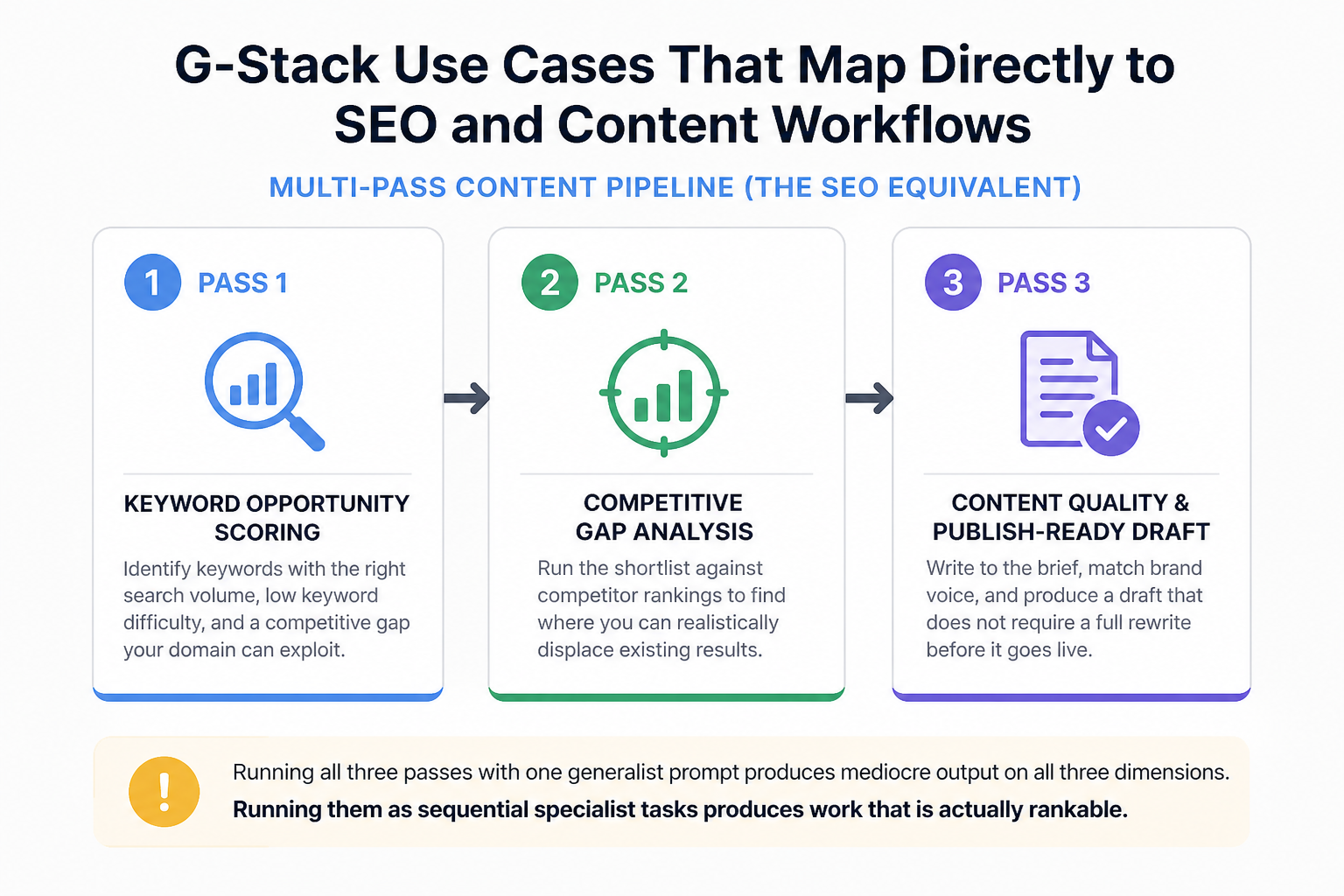
The SEO equivalent is a multi-pass content pipeline:
- Pass 1: Keyword Opportunity Scoring. Identify which keywords have the right combination of search volume, low keyword difficulty, and a competitive gap your domain can exploit.
- Pass 2: Competitive Gap Analysis. Run the shortlist against competitor rankings to find where you can realistically displace existing results.
- Pass 3: Content Quality and Publish-Ready Draft. Write to the brief, match brand voice, and produce a draft that does not require a full rewrite before it goes live.
Running all three passes with one generalist prompt produces mediocre output on all three dimensions. Running them as sequential specialist tasks produces work that is actually rankable.
Structured Planning Before Implementation: The SEO Brief Analogy
In g-stack, the Tech Lead role and /plan command exist to define scope before a single line of code is written. In content marketing, the equivalent is the SEO brief: the document that locks in the target keyword, intent match, competitive angle, and content structure before writing starts.
Teams that skip the brief produce content that ranks for nothing because it was never aligned to a specific search intent. The planning phase is not overhead. It is the decision that determines whether the work that follows is recoverable or wasted.
Orchestrating Specialist Agents for Keyword Research, Writing, and Publishing
The AI agents for SEO model that mirrors g-stack most closely is a pipeline where each stage has a defined agent with a defined scope. Keyword research is not a writing task. Writing is not a publishing task. Mixing them into one instruction set produces the same generic output that makes AI-driven personalized marketing promises fall flat.
If you want this same orchestrated, specialist-agent logic applied to your content pipeline without building it yourself, Indexly does exactly that. It identifies competitor keywords, scores opportunities, writes SEO-optimized articles with original data, and publishes them directly to your site. No manual research, no generic AI slop.
SEO Benefits of Adopting a G-Stack Mindset: From Manual Research to Agentic Pipelines
A manual keyword audit that takes four to six hours per week becomes a continuous background process when a specialist agent handles it. That time difference is where the SEO benefits compound.
Eliminating the Keyword Research Time Sink with Specialist AI Agents
Manual keyword research requires pulling data from multiple tools, cross-referencing competitor rankings, and scoring opportunities against domain rating by hand. Specialist AI agents built for this task run the same process in minutes. The output is a prioritized list with gap intelligence already embedded, not a spreadsheet that still needs human interpretation.
Automated SEO services built on this model free up strategist time for decisions that actually require human judgment, like content angle selection and brand voice direction.
Content Production at Scale Without Sacrificing Brand Voice
Generic AI content fails because it is produced by a generalist prompt with no domain context, no competitive signal, and no brand constraints. The g-stack approach fixes this by separating the content brief stage from the writing stage and feeding each specialist agent only the context it needs.
SEO organic traffic compounds when content is written to a specific intent match with a specific brand voice. Scale without quality control produces volume that dilutes domain authority rather than building it.
Publishing Automation Across CMS Platforms: Webflow, Joomla, Squarespace
Publishing bottlenecks are rarely about writing speed. They are about CMS friction. An article that finishes the editorial queue still needs to be formatted, tagged, and pushed to the platform. Webflow SEO, SEO for Joomla, and Squarespace SEO all have distinct formatting requirements that add manual steps to every piece.
Agentic publishing pipelines that connect directly to these platforms eliminate the handoff entirely. The draft moves from approved to published without a separate formatting task.
Competitive Intelligence as a Continuous Feed, Not a Quarterly Audit
Quarterly competitive audits are already outdated by the time they are presented. Competitors publish, update, and rank in real time. An AI search visibility tool running continuous gap analysis surfaces new opportunities as they appear, not three months after they were missed.
The g-stack mindset is not about using more AI tools. It is about designing specialist workflows that compound over time.
How to Choose the Right G-Stack or AI SEO Stack for Your Team
Three Questions to Ask Before Adding Any AI Skill or Agent
Tool proliferation is the failure mode the g-stack architecture is specifically designed to prevent. Before adding any skill, agent, or SEO consulting layer to your stack, answer these three questions:
- Does this skill have a clearly scoped purpose with defined invoke conditions and explicit guidance on when not to use it?
- Does my team have a planning phase before implementation, or do we route tasks directly to execution?
- Am I solving a documented bottleneck, or adding surface-level capability because the tool looks useful?
If any answer is no, the skill is not ready to add. Skill counts that grow faster than clarity of use create the same problem they are meant to solve.
When G-Stack Is the Right Tool (and When It Is Not)
G-stack is the right choice when the bottleneck is engineering workflow: code review quality, architectural planning, or multi-pass analysis of technical systems. It is a professional-services equivalent for development teams. The roles, the orchestrator, and the planning commands are built around code artifacts.
G-stack is not the right tool when the bottleneck is content production, keyword research, or organic traffic growth. The specialist roles in g-stack are scoped to engineering domains. Repurposing them for SEO tasks produces the same generic output that specialist roles exist to prevent.
Signals That You Need a Dedicated SEO Agent Instead
Switch from a general-purpose AI stack to a dedicated SEO tool when you see these symptoms:
- Keyword research takes more than two hours per week and still lacks competitive gap context
- Content is being published but organic traffic is flat or declining
- Publishing to multiple CMS platforms requires separate manual steps per platform
- Competitive audits happen quarterly because running them more often is not feasible
- AI-generated drafts require full rewrites before they meet brand voice standards
These are not abstract criteria. They are observable signs that a generalist workflow has hit its ceiling.
Conclusion
The decision here is straightforward. If your bottleneck is engineering workflow, g-stack is a proven, community-tested agentic structure with 89.7K stars and active development. Use it as designed.
If your bottleneck is SEO and content production, the same specialist-agent logic applies. You do not need to build the pipeline from scratch or repurpose an engineering tool for a marketing job. The architecture that makes g-stack work for developers is available in purpose-built form for organic growth teams.
The worst outcome is doing neither. Manual, generalist processes running at low speed produce generic output that no amount of publishing volume will turn into rankings.
If SEO is your bottleneck, see how Indexly's AI SEO agent replaces your manual research and writing pipeline. No setup required. Get started free.
Frequently Asked Questions
What is g-stack in simple terms?
G-stack is a collection of specialist AI skills for Claude Code, published by Garry Tan. It gives AI agents defined roles, planning commands, and an orchestration layer so each task is handled by a purpose-built expert rather than a single generalist prompt. The result is higher-quality output across complex, multi-step workflows.
Who created g-stack and when was it released?
Garry Tan created g-stack. The most recent version, v1.26.3.0, was released on May 4, 2026, and added the /sync-gbrain skill along with a native code-surface orchestrator.
How is g-stack different from other Claude Code skill collections?
G-stack emphasizes deliberate skill selection over volume. Each skill has a defined scope, specific invoke conditions, and guidance on when not to use it. The native orchestrator coordinates specialist agents across multi-pass workflows. Other collections often prioritize feature count without the same structural discipline.
Can non-developers use g-stack or the g-stack approach for marketing workflows?
Non-developers cannot directly use g-stack, which is scoped to code-related engineering tasks. The underlying approach, using specialist AI agents in a planned, sequential pipeline rather than one generalist prompt, applies directly to marketing workflows like keyword research, content production, and publishing automation.
What is the SEO equivalent of a g-stack agentic pipeline?
The SEO equivalent is a structured pipeline where separate specialist agents handle keyword opportunity scoring, competitive gap analysis, content writing with brand voice constraints, and CMS publishing. Each stage has a defined input, a defined scope, and a defined output. Running these in sequence produces better results than a single AI prompt attempting all four tasks at once.
How many skills should you install in g-stack to avoid overlap and confusion?
Install only skills that have clearly non-overlapping purposes. There is no correct number. The test is whether each skill has a distinct invoke condition that does not conflict with another skill already in your stack. When two skills have similar descriptions, keep the one with tighter scope and clearer boundaries. Skill count is not a quality signal.