Ghostwriter AI Tools: 7 Best Picks for 2026
Find the best ghostwriter AI tools that skip the slop. Our 2026 roundup covers 7 picks built for content marketers who need real voice and real results.


AI writing tools promised to kill the content bottleneck. Instead, most produced a flood of generic, voice-free output that reads the same across every competitor's blog. Google has noticed. So have readers. This is the AI slop problem, and it is getting worse as more marketers reach for the same tools with the same default prompts.
The ghostwriter AI category is supposed to solve this. Some tools do. Most do not.
This article ranks 7 ghostwriter AI tools against the criteria that actually move SEO outcomes: keyword intelligence, brand voice preservation, publishing automation, and original data generation. Authenticity, voice, and originality are increasingly what separates content that ranks from content that gets ignored. By the end, you will know exactly which tool fits your workflow and which ones to skip.
What Makes a Ghostwriter AI Tool Actually Useful for SEO in 2026
Most ghostwriter AI tools are evaluated on output fluency. That is the wrong test. The right test is whether the tool improves your SEO workflow end-to-end, not just whether the sentences sound smooth.
Ask every vendor these five questions before committing.
Keyword intelligence vs. generic prompt-based writing
Does the tool start with keyword data, or does it wait for you to supply a topic? Tools that rely on open-ended prompts shift the research burden back to you. Tools with built-in keyword intelligence find gaps before you write a single word.
Brand voice preservation: why it separates good tools from AI slop
Can the tool document and replicate your brand voice consistently across writers and campaigns? Publishers and clients are demanding clearer disclosure of exactly how AI is used in content creation, and contract language around AI usage is tightening fast. Brand voice documentation is no longer a nice-to-have. It is a business-critical feature that protects you when a client asks how the content was produced.
Publishing automation and CMS integration
Does the tool publish directly to your CMS, or does it hand you a Google Doc? Every manual step between generation and publication is a place where content dies in a queue.
Original data and visual content generation
Can the tool produce original data points, charts, or infographics? Generic prose is easy to replicate. Original visuals and data are not.
Pricing transparency and scalability for marketing teams
Does the pricing scale with output volume, or does it penalize growth with seat-based fees? Ask for the total cost at your current content volume before trialing anything.
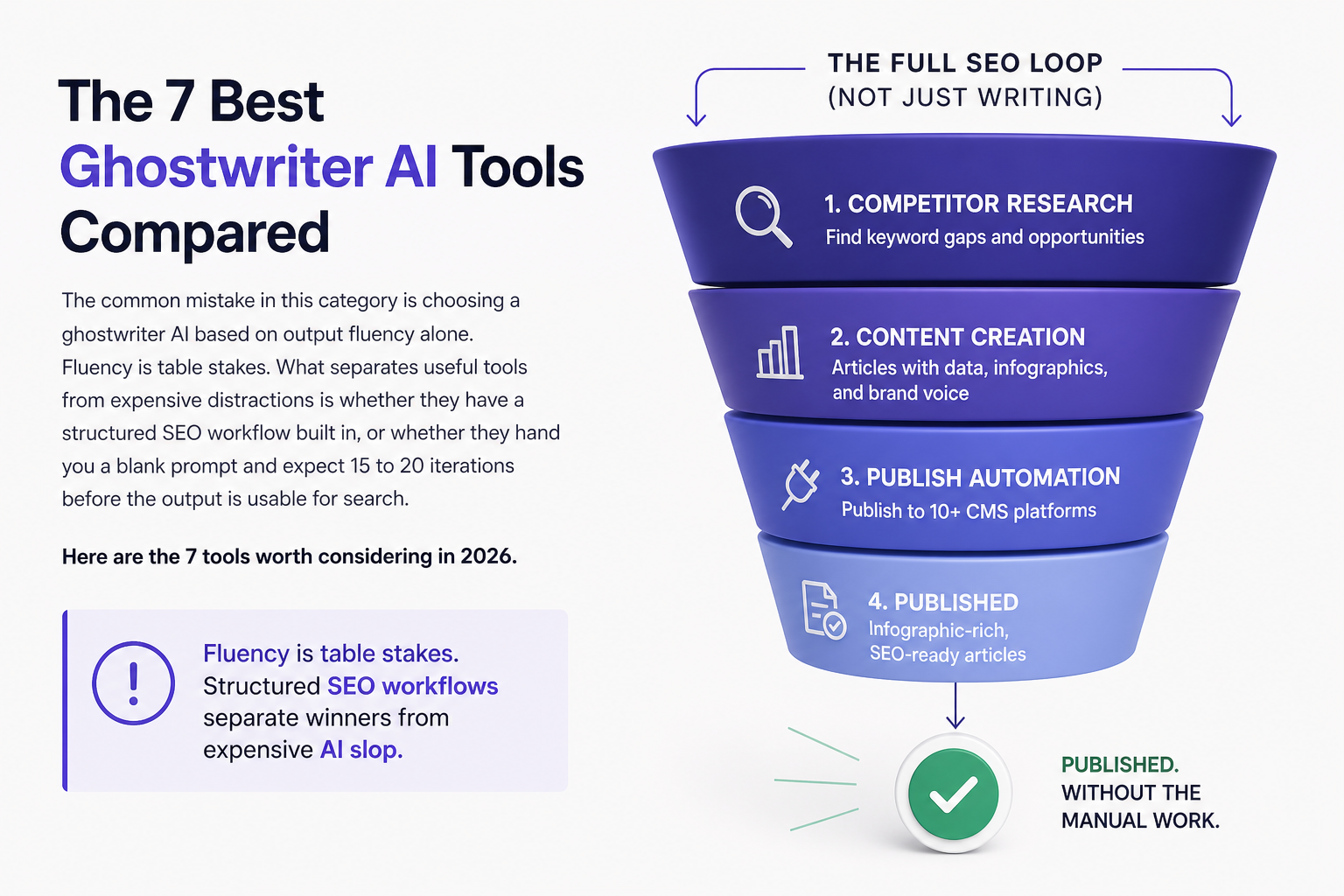
The 7 Best Ghostwriter AI Tools Compared
The common mistake in this category is choosing a ghostwriter AI based on output fluency alone. Fluency is table stakes. What separates useful tools from expensive distractions is whether they have a structured SEO workflow built in, or whether they hand you a blank prompt and expect 15 to 20 iterations before the output is usable for search.
Here are the 7 tools worth considering in 2026.
1. Indexly — Best Ghostwriter AI for Full-Funnel SEO Automation
Verdict: The only ghostwriter AI on this list that closes the full SEO loop from competitor research to published article.
- Automatically identifies competitor keyword gaps and scores opportunities using search volume, keyword difficulty, and domain rating
- Generates articles with original data, infographics, and brand voice matching baked in
- Publishes directly to 10+ CMS platforms including WordPress, Webflow, Shopify, and Framer
Weakness: Overkill for teams that only need occasional one-off content without an SEO growth mandate.
Best for: SEO-first marketing teams that need a repeatable, automated content pipeline, not just a writing assistant.
If your bottleneck is the entire SEO workflow and not just the writing, Indexly is built for that. It is the only ghostwriter AI on this list that starts with competitor intelligence and ends with a published, infographic-rich article without a human in the loop.
Pricing: Subscription-based; plans scale by output volume.
2. Jasper AI — Best for Brand Voice Templates Across Marketing Teams
Verdict: Strong brand voice controls make it the top choice for larger teams maintaining consistency across multiple writers.
- Brand voice profiles that apply across all content types and campaigns
- Deep template library covering ads, emails, blog posts, and social copy
- Integrates with Surfer SEO for on-page optimization signals
Weakness: No native keyword research or competitor gap analysis. You bring the strategy; Jasper handles the writing.
Best for: Marketing teams with an existing SEO strategy who need consistent voice at scale.
Pricing: Starts around $49/month; Creator and Teams plans available.
3. Copy.ai — Best for Marketing Campaign Copy at Scale
Verdict: Built for volume production of campaign copy across multiple formats and channels.
- Workflow automation for multi-step campaign copy sequences
- Strong for automated marketing campaigns including email, ads, and landing pages
- Large prompt library reduces iteration time on standard marketing formats
Weakness: Blog and long-form SEO content quality lags behind dedicated article tools.
Best for: Growth marketers running high-volume campaign copy across paid and organic channels.
Pricing: Free tier available; paid plans start around $49/month.
4. Writesonic — Best Budget Ghostwriter AI for Small Business
Verdict: Delivers solid SEO article output at a price point that works for small marketing teams.
- Built-in Surfer SEO integration for keyword-optimized drafts
- Article generation workflow reduces prompt iteration significantly
- Covers blog posts, product descriptions, and social content in one platform
Weakness: Brand voice controls are limited compared to Jasper. Output can feel formulaic across topics.
Best for: Small businesses and solo marketers who need SEO-ready drafts without a large software budget.
Pricing: Free tier available; paid plans start around $20/month.
5. Anyword — Best for Predictive Performance Scoring
Verdict: Unique predictive scoring engine tells you which copy variation is likely to perform before you publish.
- Predictive performance scores on headlines, ads, and email subject lines
- Strong for digital marketing teams running A/B testing across paid channels
- Brand voice controls with style guidelines enforcement
Weakness: Performance predictions are strongest for short-form copy. Long-form SEO articles are not its primary strength.
Best for: Performance marketers who need data-backed copy decisions on ads and email campaigns.
Pricing: Starts around $49/month; Business plans for larger teams.
6. Surfer SEO + AI Editor — Best for On-Page Optimization Depth
Verdict: The most granular on-page SEO tool on this list, though it requires more manual input than pure ghostwriter AI tools.
- Real-time content score based on competitor analysis and NLP keyword signals
- AI editor generates and optimizes drafts inside the Surfer workflow
- Topic clusters and internal linking recommendations built into the editor
Weakness: The workflow is research-heavy. It accelerates optimization but does not replace the upstream keyword strategy or competitor gap work.
Best for: SEO specialists who want deep on-page control and are comfortable running their own keyword research upstream.
Pricing: Plans start around $89/month.
7. Notion AI — Best Lightweight Option for Solo Content Marketers
Verdict: A practical writing assistant for solo marketers already living inside Notion, with no learning curve.
- Drafts, edits, and summarizes content inside existing Notion workspaces
- Low cost addition to an existing Notion subscription
- Works well for content briefs, outlines, and first draft acceleration
Weakness: No SEO features, no keyword intelligence, no CMS publishing. It is a writing aid, not an SEO tool.
Best for: Solo content marketers who need a fast drafting layer inside their existing workflow without adding another platform.
Pricing: Add-on to Notion plans; approximately $10/month per member.
Ghostwriter AI vs. Human Ghostwriters: Where the Line Is in 2026
Ghostwriter AI tools in 2026 are best used for keyword-driven SEO articles, product descriptions, and campaign copy. They are not reliable replacements for thought leadership, author-branded books, or content requiring verifiable original research without AI assistance.
What AI ghostwriting handles well (and where it still fails)
AI ghostwriting tools handle structure, keyword coverage, and volume well. They fail on genuine insight, novel perspective, and content that requires lived experience or verified expertise. The output gap shows up most clearly in content where the author's credibility is the product, not just the information.
Disclosure norms and contract language marketers need to know
Contract language around AI use in content is tightening. It is now becoming as standard as rights and royalties clauses in publishing and agency agreements. The practical implication for content marketers is direct: document your AI stack and your usage policy before a client or publisher asks. Clients are demanding clear guidelines on exactly how AI is used in their content, and the cat-and-mouse dynamic between AI generation and AI detection is not going away. Get ahead of it now.
The brand voice risk: why AI slop costs you more than slow output
Generic AI output does not just underperform. It actively damages brand perception when readers recognize that the content sounds identical to every competitor's blog. Authenticity and originality are increasingly valued signals, both by readers and by search algorithms. A slow content operation with a distinct voice outperforms a fast one producing AI slop.
How to Choose the Right Ghostwriter AI Tool for Your Marketing Stack
The fastest way to waste a software budget is to buy a tool for features you will use 10% of. Solo marketers on tight budgets report this pattern repeatedly: they choose the most feature-rich option and spend more time learning the platform than producing content. Match the tool to your actual workflow stage.
For solo marketers and small businesses: prioritize simplicity and cost
You need fast drafts at low cost, not an enterprise automation layer. Avoid tools that require significant onboarding or have complex prompt workflows. Start with Writesonic or Notion AI, depending on whether SEO output quality or workflow simplicity matters more to you.
For marketing teams and agencies: prioritize workflow integration and brand controls
Your risk is inconsistent brand voice across multiple writers and campaigns. You need tools that enforce style guidelines automatically and integrate with your existing project management stack. Jasper AI is the strongest fit here for brand control at team scale.
For SEO-first growth teams: prioritize keyword intelligence and publishing automation
If your primary goal is organic traffic growth through consistent content output, the writing layer is only one part of the problem. You need keyword gap intelligence, opportunity scoring, and direct CMS publishing to remove the manual steps that stall pipelines. Indexly is the only tool in this list built specifically for that full workflow.
The Decision Comes Down to One Question
The right ghostwriter AI depends on whether you need a writing assistant or a full SEO workflow.
If you need a writing assistant, any of the tools in this list will reduce production time. Pick based on your budget and team size using the paths above. If you need the full loop, from competitor keyword gaps through content generation, original data, and direct CMS publishing, the list narrows to one.
AI content quality is raising the bar across every niche in 2026. Tools that produce generic output are becoming a liability, not just a limitation.
See how Indexly automates your entire SEO content pipeline, from competitor keyword gaps to published article, without a single manual step. Get started free.
Frequently Asked Questions
What is a ghostwriter AI and how does it differ from a standard AI writing tool?
A ghostwriter AI is designed to produce publish-ready content in a specified author's voice, style, or brand, rather than generic output. Standard AI writing tools generate text from prompts without voice matching or SEO workflow integration. Ghostwriter AI tools add brand voice controls, structured content workflows, and often direct publishing capabilities that general-purpose tools lack.
Can ghostwriter AI tools match a specific brand voice?
Yes, but the quality varies significantly between tools. Jasper AI and Indexly offer the strongest brand voice controls, including style guide enforcement across content types. Most other tools on this list offer basic tone settings rather than true brand voice replication. The more specific your voice documentation, the better the output.
Is AI-generated ghostwritten content detectable by Google?
Google's public position is that it rewards helpful, high-quality content regardless of how it is produced. What it penalizes is thin, low-value content, which describes most AI slop. Well-structured, keyword-intelligent, original AI content performs well in search. The detection risk is higher from clients and publishers using AI content checkers than from Google's ranking algorithm directly.
What is the best ghostwriter AI tool for SEO content in 2026?
For full-funnel SEO automation combining keyword research, content generation, and CMS publishing, Indexly leads this list. For teams that need strong brand voice controls without the full SEO automation layer, Jasper AI is the strongest alternative. For budget-conscious small businesses, Writesonic offers the best value for SEO article output.
Do I need to disclose that I used an AI ghostwriter for published content?
Disclosure requirements depend on context. For branded marketing content you own, there is no universal legal requirement. For client work, publisher agreements, or author-attributed books, contract language around AI use is tightening fast and disclosure is increasingly expected. Document your AI usage policy and review client contracts carefully before publishing AI-assisted content under someone else's name.