How to Make It Shorter: Cut Words Without Losing SEO Value
Learn how to make it shorter without losing keyword signals, featured snippet eligibility, or topical authority. A four-layer framework for cutting SEO content.


Most SEO content is bloated by design. Writers pad to hit word counts, agencies pad to justify invoices, and AI pads because no one told it to stop. The result is content that ranks poorly not despite its length, but partly because of it.
Google does not reward length. It rewards relevance density. A 600-word article that answers the query completely outperforms a 2,000-word article that buries the answer in filler. The real cost of bloat is not just reader friction. It is diluted topical authority, wasted crawl budget, and featured snippet eligibility handed to a tighter competitor.
Content teams know this pain. Hours spent trimming AI-generated drafts that still read like AI slop after three rounds of editing. The goal of this guide is a repeatable decision framework: how to make it shorter without dropping keyword signals, featured snippet eligibility, or topical authority.
Why Making Content Shorter Is an SEO Decision, Not Just an Editing One
Cutting words is not a style preference. It is a technical SEO lever with measurable effects on crawl efficiency, keyword density, and how clearly your content maps to search intent.
Relevance Density: What Google Actually Measures
Relevance density is the ratio of meaningful, query-relevant content to total word count. A page with 400 words tightly focused on one topic signals clearer topical intent than an 1,800-word page where the same topic shares space with tangents, disclaimers, and filler transitions.
Crawl budget matters here too. Googlebot allocates crawl time per domain. Shorter, denser pages get fully parsed faster. Bloated pages risk shallow crawls that miss your best keyword signals buried in paragraph four.
The Word Count Myth That Is Costing You Rankings
The belief that longer content ranks better persists because it was true in a narrow window, roughly 2015 to 2019, when thin content was the dominant problem. That window closed. Relying on manual length targets without measuring relevance density is one of the most common mistakes content teams still make today.
The writing simplifier logic is simple: if a sentence does not add a new point, proof, or transition, it dilutes the signal of every sentence around it. A sentence compressor that removes 30% of words while keeping 100% of keyword occurrences increases density by default.
When Short Sentences Generator Logic Beats Long-Form Padding
Here is a concrete example. Both versions below contain the same four keyword signals: "SEO audit," "crawl budget," "internal links," and "site structure."
|
Version |
Word Count |
Keyword Signals |
Relevance Density |
|---|---|---|---|
|
Padded |
120 words |
4 |
Low |
|
Compressed |
60 words |
4 |
High |
Padded version (120 words): "When you are thinking about conducting an SEO audit for your website, it is really important to consider a wide range of factors that can have a significant impact on your overall performance in search engines. One of the things you will want to look at is your crawl budget, which refers to how many pages Googlebot will crawl on your site within a given time period. You should also think about your internal links and how they connect the various pages on your website. Additionally, your site structure plays a role in determining how search engines navigate and index your content, so it is worth reviewing that as part of your audit."
Compressed version (60 words): "An SEO audit should start with crawl budget. If Googlebot cannot efficiently reach your pages, rankings stall regardless of content quality. Audit your internal links first: they are the map Googlebot follows. Then review site structure to confirm every important page sits within three clicks of the homepage. Fix those two layers and your audit covers 80% of crawlability issues."
Same keyword signals. Half the words. The compressed version answers faster, scans better, and earns higher relevance density.
The Four-Layer Test: What to Cut When You Make It Shorter
Auditing a draft for bloat is faster when you work through four specific categories in sequence. Each layer targets a different type of word waste, and each has a direct SEO consequence.
Layer 1: Filler Transitions and Throat-Clearing Phrases
These are sentences that exist to connect ideas that should connect naturally. Phrases like "It is worth noting that," "As we mentioned earlier," or "Now, let us take a look at" add zero keyword signal and consume crawl parsing time.
Before: "It is worth noting that keyword research is an important part of any SEO strategy." After: "Keyword research drives every SEO decision."
SEO impact: removing filler increases the keyword-to-word ratio on the page without touching actual content.
Layer 2: Redundant Modifiers and Simplified Words
Adjectives and adverbs that restate what the noun already implies are word waste. "Very unique," "completely free," "extremely important" all add length without adding meaning. A simple English converter approach strips these automatically.
Before: "This is a very unique and highly effective method for improving your rankings significantly." After: "This method improves rankings."
SEO impact: tighter sentences let your actual keyword phrases stand out rather than hiding inside modifier chains.
Layer 3: Passive Voice and Inflated Verb Phrases
Passive constructions inflate word count and reduce sentence clarity. "Was determined to be" costs three words. "Is" costs one. Active voice also maps more cleanly to featured snippet extraction, where Google pulls direct declarative statements.
Before: "The decision was made by the team to implement a new content strategy." After: "The team implemented a new content strategy."
SEO impact: active declarative sentences are the format Google prefers for snippet pulls.
Layer 4: Off-Topic Tangents That Dilute Topical Authority
Every paragraph that drifts from the core topic signals mixed intent to crawlers. Topical authority is built by covering one topic thoroughly, not by adding adjacent topics that belong in separate articles. Off-topic tangents hurt your pillar-supporting article structure.
Before: A paragraph about social media marketing for nonprofits inside an article about SEO audits. After: Cut entirely, or moved to a dedicated supporting article.
SEO impact: cleaner topical focus improves the page's chance of ranking for its target cluster.
One rule to memorize: if a sentence does not advance the answer to the article's core query, it is costing you density without buying you coverage.
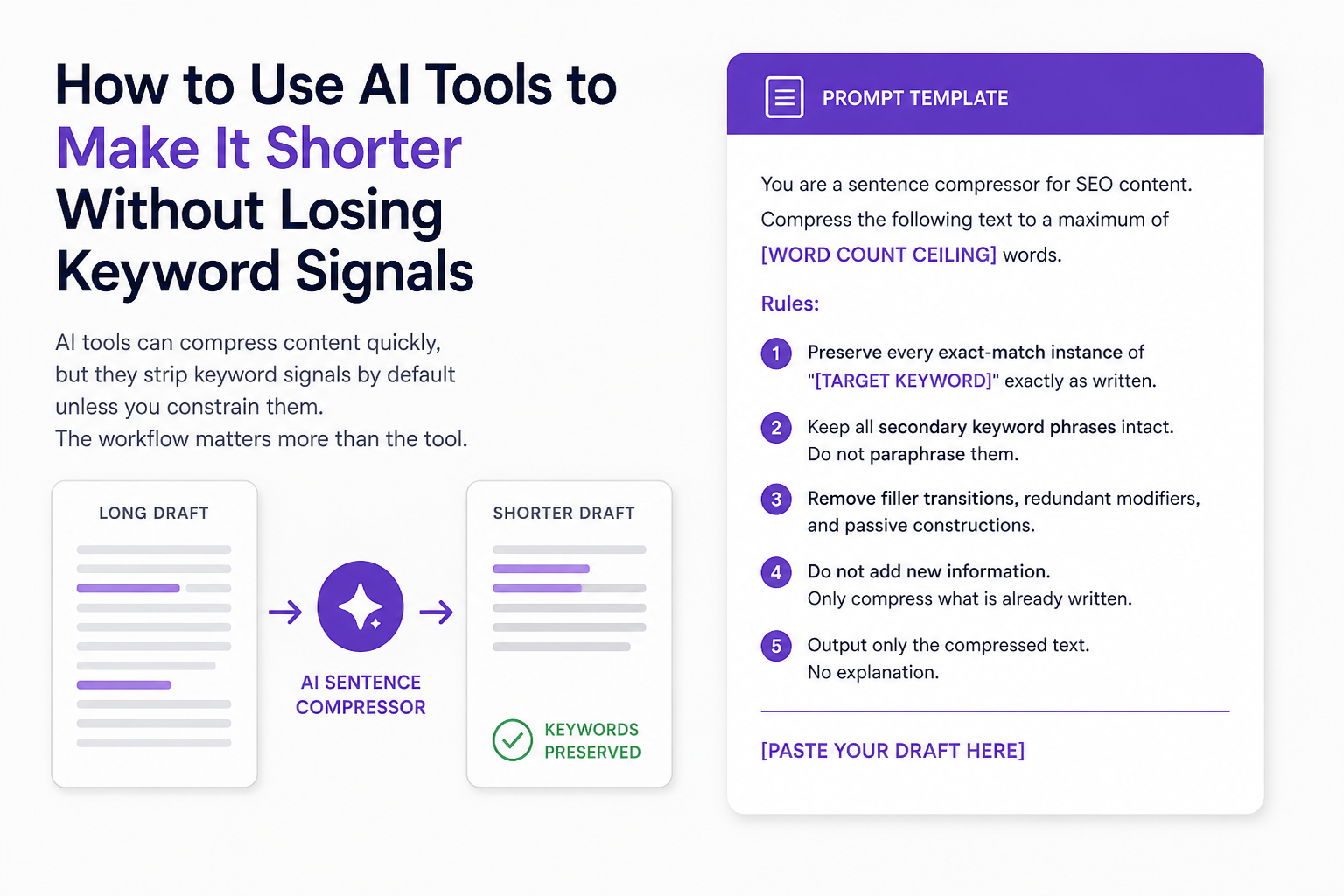
How to Use AI Tools to Make It Shorter Without Losing Keyword Signals
AI tools can compress content quickly, but they strip keyword signals by default unless you constrain them. The workflow matters more than the tool.
Choosing the Right AI Sentence Helper for Compression vs. Rewriting
An AI sentence helper optimized for compression shortens existing text while preserving structure. A full AI rewriter regenerates the paragraph from scratch, which risks dropping exact-match keyword phrases you need for ranking.
Use a sentence compressor when you have a draft that is structurally sound but too long. Use a rewriter only when the original is so bloated that compression alone cannot fix it. Treating these as the same tool is where teams lose keyword signals.
Prompting a Sentence Compressor to Preserve Target Keywords
The prompt template below works across most AI text editors. Copy it directly:
```
You are a sentence compressor for SEO content.
Compress the following text to a maximum of [WORD COUNT CEILING] words.
Rules:
- Preserve every exact-match instance of "[TARGET KEYWORD]" exactly as written.
- Keep all secondary keyword phrases intact. Do not paraphrase them.
- Remove filler transitions, redundant modifiers, and passive constructions.
- Do not add new information. Only compress what is already written.
- Output only the compressed text. No explanation.
[PASTE YOUR DRAFT HERE]
```
Replace [WORD COUNT CEILING] with your target and [TARGET KEYWORD] with your primary keyword phrase. Running this before any other editing step protects your keyword signals from the start.
How to Un-AI Text After Compression: Restoring Brand Voice
Compressed AI output tends to flatten to a generic register. How to un-AI text after compression comes down to two passes: replace generic sentence openers with ones specific to your topic, and reintroduce any branded terminology that the AI neutralized.
A free AI text editor handles compression well. Restoring brand voice requires a human editor or a second AI pass using a brand voice prompt. Build this two-step into your workflow rather than treating it as optional cleanup.
Free AI Text Editor vs. Paid Shortener AI: When Each Makes Sense
Free tools handle single-paragraph compression reliably. For full article audits, bulk compression across a content library, or compression that must preserve a specific keyword density target, paid shortener AI tools offer more control and consistent output.
The real limitation of both is that they operate downstream. They fix a draft that was already too long. If your content workflow still starts with a bloated first draft, compression tools are patching a production problem, not solving it.
Indexly approaches this from the other direction. Its AI SEO agent analyzes competitor keyword data before writing, so the first draft is already scoped to the right length and keyword density. You skip the compress-then-check loop entirely because the draft was calibrated from the start.
Protecting Featured Snippet Eligibility When You Make It Shorter
You can make it shorter without losing featured snippet eligibility if you preserve one direct answer block of 40 to 55 words in plain declarative language. Google does not pull the longest answer. It pulls the clearest one. Cutting surrounding filler often improves snippet eligibility rather than hurting it.
What Google Pulls for Snippets and Why Length Is Not the Factor
Google's snippet extraction targets the passage that most directly answers the query. That passage does not need to be long. It needs to be structured as a direct answer, use plain language, and sit near the top of the section it appears in.
Removing padded paragraphs around your answer block does not disqualify the block. It makes the block more visible to the extraction algorithm by reducing the noise around it.
The 40-60 Word Answer Block: Format That Survives Compression
Structure your answer block as two to three short declarative sentences. Lead with the direct answer. Follow with one clarifying sentence. Close with a consequence or action. This format holds across compressions because the structure itself signals answer intent.
If your answer block currently runs 90 words, compress it to 55 without removing any keyword phrases. The shorter version is more snippet-eligible, not less.
Tone Detection and Sentence Structure Signals Google Prefers
Google's tone detection for snippets favors neutral, declarative constructions over hedged or conversational ones. Phrases like "it depends" or "there are many factors" reduce snippet eligibility. Direct subject-verb-object sentences increase it.
For teams tracking both traditional snippets and answer engine optimization results, the same principle applies in LLM-based answer engines. LLMO (large language model optimization) rewards dense, factual, declarative content even more than traditional snippet targeting does. An LLM rank tracker will show that your tightest, most direct content earns the most citation appearances in AI-generated answers.
Applying Short Content Logic Across Email, Social, and On-Page Copy
The same compression discipline that tightens blog posts applies across every content channel. The mistake is trimming articles while leaving emails, social posts, and meta copy bloated by the same word waste patterns.
Email Response and AI Email Writing: Cutting Without Losing Conversion
Keep email subject lines under 41 characters. Subject lines above 60 characters are truncated on most mobile clients, cutting off the keyword phrase that drives the open. AI for email writing tools generate subject lines that often run long by default. Run every subject line through a character count before sending.
For email body copy, the compression rule is one idea per paragraph. An email response that makes three points in three tight paragraphs converts better than one paragraph that buries all three points together.
Social Media Content: Platform Character Limits as a Compression Forcing Function
LinkedIn posts above 150 words before a "see more" break lose a significant share of impressions. Treat that 150-word limit as a hard ceiling, not a guideline. Social media content that respects platform character limits forces compression discipline that improves the writing itself.
For social media marketing for beginners, this is the fastest way to improve content quality: let the character limit do the editing for you.
On-Page SEO Copy: Headline Generator Logic for Tighter Meta and H1s
Meta titles perform best under 60 characters. H1s should answer the query in the first five words. Using headline generator logic means leading with the keyword, not building to it.
Rephrase professionally does not mean making copy longer. It means making it precise. A meta description that reaches its keyword in the first eight words earns more clicks than one that arrives at the keyword in word fifteen.
Conclusion
Every hour spent trimming a bloated draft is an hour not spent on strategy, distribution, or the next article. The compression framework in this guide works, but it is still a reactive fix applied to a production problem that started upstream.
The operational choice is between editing drafts down to the right length after writing and building content that starts at the right length because the keyword scope was defined before writing. One is a workflow habit. The other is a production architecture change.
If your content workflow still starts with a long draft you have to cut down, that is the problem. Indexly builds keyword-scoped, length-calibrated articles from competitor data before a single word is written. See how it works. No demo call required.
Frequently Asked Questions
Does making an article shorter hurt its SEO rankings?
Not if you preserve keyword signals and topical coverage. Cutting filler, redundant modifiers, and off-topic tangents typically improves relevance density, which is a positive ranking signal. The risk comes from cutting content that answers secondary queries within the same article. Audit what you remove, not just how many words you remove.
What is the fastest way to make a sentence shorter without losing meaning?
Remove the first three to five words of any sentence that opens with a filler phrase, then check if the remaining sentence still makes the point. In most cases it does. "It is important to note that keyword research matters" becomes "Keyword research matters." Same meaning, half the words.
Can AI tools reliably compress content without removing keyword signals?
Only if you prompt them to preserve exact-match keyword phrases explicitly. Without that instruction, AI sentence generators paraphrase by default, which replaces exact-match phrases with synonyms that do not carry the same ranking signal. Use the prompt template in this guide to constrain compression behavior.
How short is too short for an SEO article targeting a competitive keyword?
There is no universal floor, but an article that fails to cover the topic's core subtopics will lose to a competitor that does, regardless of length. The test is not word count. It is whether every question a searcher with that intent would ask is answered somewhere in the article. Use competitor gap analysis to identify which subtopics you cannot cut.
What is the difference between a sentence compressor and a full AI rewriter?
A sentence compressor reduces word count while preserving the original sentence's structure and keywords. A full AI rewriter regenerates the sentence from scratch, which changes both structure and keyword phrasing. Use a compressor when the original is sound but too long. Use a rewriter only when the original is structurally broken and compression alone cannot fix it.