Lyfe Marketing Alternatives for Growth Marketers
Lyfe Marketing excels at account management, but if you need content velocity and SEO scale, these alternatives deliver faster, smarter results.

![Editorial illustration for The Best Lyfe Marketing Alternatives for Growth Marketers [2026]](/_next/image?url=https%3A%2F%2Fw1abfkfuy7wulwpu.public.blob.vercel-storage.com%2Flyfe-marketing-alternatives-thumbnail.png&w=3840&q=75)
Lyfe Marketing earns genuine praise for account management and social media execution. Clients describe their team as responsive, organized, and capable of grasping complex business goals quickly. But if your bottleneck is keyword research backlog, content throughput, or publishing velocity, a responsive account manager is not the solution you need.
The tension is structural. Managed agency models like Lyfe Marketing trade automation for relationship. Every content asset requires a brief, a writer, a review cycle, and an approval. In 2026, that trade-off is optional, not necessary.
This article gives growth marketers a ranked comparison of Lyfe Marketing alternatives across SEO automation, AI content generation, and managed services, so you can make a direct replacement decision based on your actual bottleneck, not agency marketing copy.
Why Growth Marketers Are Looking Beyond Lyfe Marketing
The question is not whether Lyfe Marketing is competent. The question is whether a managed agency model can structurally solve a content throughput problem.
What Lyfe Marketing Does Well: Social Execution and Account Management
Lyfe Marketing's reputation is built on social media management and client communication. Reviews consistently highlight account managers who keep complex onboarding on schedule, communicate clearly under pressure, and treat client businesses as extensions of their own team.
One client described the experience as having Lyfe "free up valuable time" by handling execution, letting the business focus on its core operations. That outcome is real and valuable for brands that need social presence without internal bandwidth.
Where the Model Breaks Down: SEO Scale, Keyword Research, and Content Throughput
The same managed model that makes Lyfe Marketing reliable for social execution becomes a ceiling for SEO growth. A common mistake in inbound marketing is limiting content strategy to lead acquisition while ignoring deep keyword research and systematic opportunity identification. Managed agencies often optimize for deliverable volume, meaning a set number of posts or articles per month, rather than search intelligence.
When your keyword research backlog has 200 untouched competitor gap opportunities, publishing four articles a month is not an SEO strategy. It is a placeholder.
The Core Trade-Off: Managed Relationships vs. Automated Output
Managed SEO marketing agency models sell human judgment and accountability. That has genuine value in brand-sensitive categories. But for growth marketers who need to scale organic traffic without scaling headcount, the relationship model adds cost per output unit without reducing the research and writing bottleneck.
The SEO management problem is not effort. It is throughput architecture.
How to Evaluate a Lyfe Marketing Alternative Without Wasting a Quarter
Picking the wrong alternative means six months of ramp time, onboarding cost, and lost ranking opportunities. Use these four criteria before signing any contract.
Criterion 1: Does It Automate Keyword Discovery or Just Report on It?
Most tools report on keywords you already know about. True automation identifies competitor keyword gaps your domain can realistically rank for, then scores them by opportunity. If the tool still requires a human analyst to interpret and prioritize the output, the bottleneck moves but does not disappear.
Criterion 2: Can It Produce Publish-Ready Content at Scale Without AI Slop?
AI content generation is widespread. Publish-ready content with original data, brand voice matching, and embedded structure is not. The standard to apply: would a senior editor approve this article without a rewrite? If the answer is "after significant editing," the tool has not solved your content bottleneck.
Criterion 3: Does Pricing Scale With Your Output, Not Your Headcount?
Agency pricing ties cost to team size or retainer level. Platform pricing should tie cost to output volume. If adding ten more articles per month requires upgrading to a higher seat tier rather than a higher output tier, the pricing model is misaligned with content scale goals.
Criterion 4: How Deep Is CMS and Publishing Integration?
A tool that writes an article but requires manual copy-paste into WordPress has not eliminated the publishing workflow. Direct integration with your CMS, including metadata, internal linking, and image placement, is the difference between 80% automation and 100% automation.
|
Criterion |
What to look for |
Red flag |
|---|---|---|
|
Keyword discovery |
Automated gap analysis vs. competitor domains |
Manual keyword lists only |
|
Content quality |
Publish-ready with brand voice |
Requires heavy editing |
|
Pricing model |
Scales with output volume |
Tied to seats or retainer |
|
CMS integration |
Direct publish to your stack |
Copy-paste workflow |
A warning worth absorbing: choosing an alternative based on vanity metrics like domain authority or impression volume, rather than organic traffic growth and content output velocity, is how teams waste a full quarter on the wrong platform.
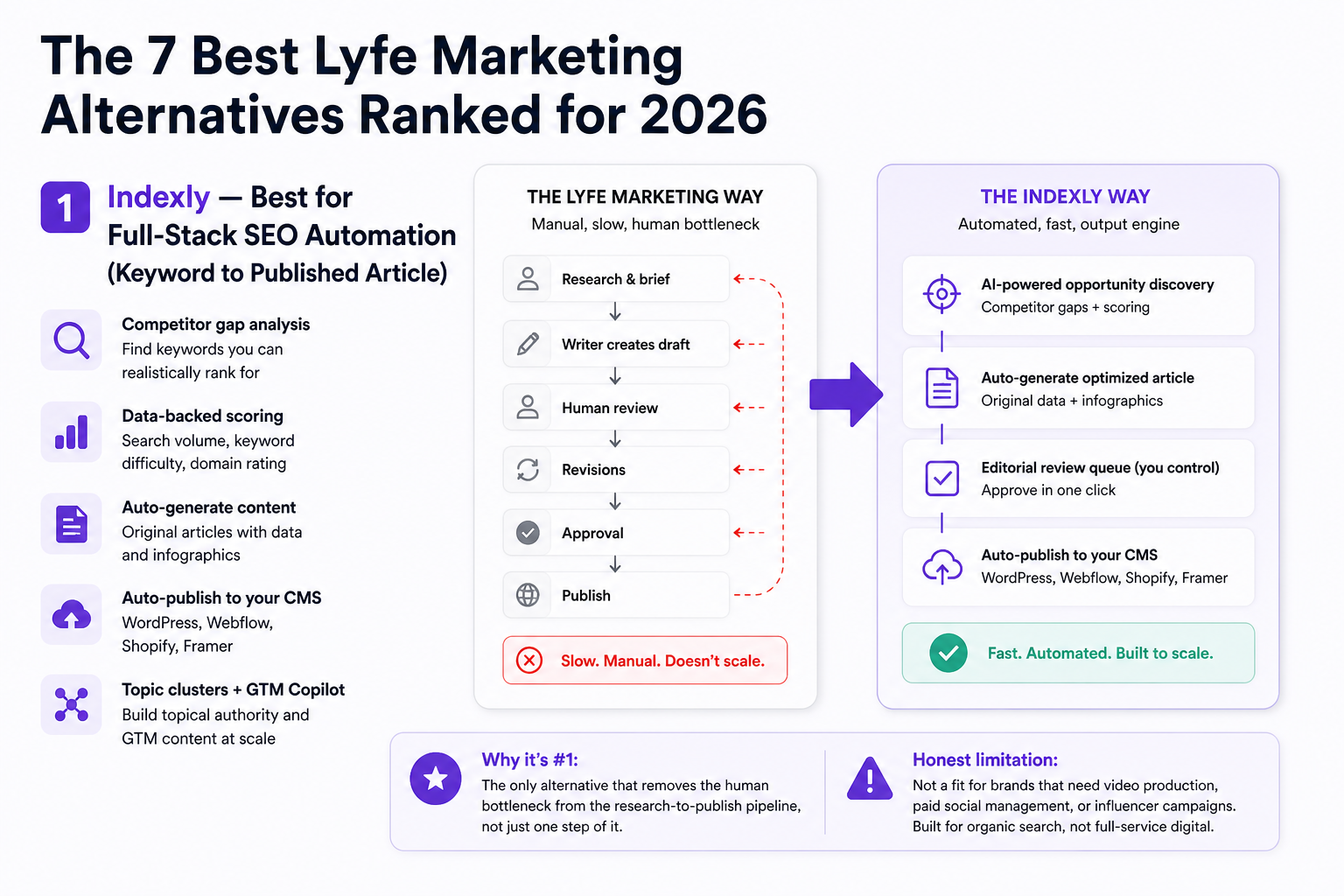
The 7 Best Lyfe Marketing Alternatives Ranked for 2026
1. Indexly — Best for Full-Stack SEO Automation (Keyword to Published Article)
Best for: Growth teams that need to publish 20+ SEO-optimized articles per month without adding headcount.
What it does that Lyfe Marketing doesn't: Where Lyfe Marketing hands you an account manager, Indexly hands you an output engine. It runs competitor gap analysis to identify keywords your domain can realistically rank for, scores each opportunity against search volume, keyword difficulty, and domain rating, then writes the article with original data and infographics embedded. It pushes the finished article directly to your CMS, including WordPress, Webflow, Shopify, and Framer, through an editorial review queue you control. Lyfe requires a human to brief, review, and approve every content asset. Indexly eliminates that loop entirely, making it the only alternative on this list that removes the human bottleneck from the research-to-publish pipeline, not just one step of it. Topic clustering for topical authority and a GTM Copilot for go-to-market content add strategic depth beyond single-article production.
Pricing: Free plan available; paid plans scale by output volume. Start free at useindexly.com.
Honest limitation: Not a fit for brands that need video production, paid social management, or influencer campaigns. Indexly is built for organic search, not full-service digital marketing.
2. WebFX — Best Full-Service Digital Agency for Mid-Market Brands
Best for: Mid-market companies that need a single agency handling SEO, paid, and content under one roof.
What it does that Lyfe Marketing doesn't: WebFX operates at larger scale with a broader service menu, including technical SEO audit capabilities, revenue-tracking dashboards, and dedicated account pods that cover both SEO digital marketing services and paid channels. Their proprietary reporting platform ties SEO activity to pipeline, not just rankings.
Pricing: Starts around $3,000/month for SEO retainers; scales with scope.
Honest limitation: Onboarding is structured and thorough, which means slower speed to first published asset compared to AI-native platforms.
3. Victorious SEO — Best Pure-Play SEO Agency for Organic Growth
Best for: Brands that want an expert SEO services provider focused entirely on organic search with no distraction from paid or social.
What it does that Lyfe Marketing doesn't: Victorious specializes in technical SEO and link building with documented case studies across ecommerce and SaaS. Their SEO consulting services are structured around long-term organic growth rather than monthly deliverable counts.
Pricing: Custom; typically mid-to-upper market retainers.
Honest limitation: No content automation. Content production is manual, which preserves quality but limits throughput for teams that need 15+ articles per month.
4. Ignite Visibility — Best for Integrated Paid + Organic Campaigns
Best for: Growth teams running paid search and SEO simultaneously who need unified attribution.
What it does that Lyfe Marketing doesn't: Ignite runs paid and organic channels inside the same strategy framework, which reduces the attribution confusion that comes from managing two separate agencies. They operate as a top-tier agency with transparent forecasting.
Pricing: Custom; minimum engagements typically start above $2,500/month.
Honest limitation: The integrated model adds cost. Teams that only need SEO will pay for paid channel overhead they do not use.
5. Single Grain — Best for SaaS and Tech-Forward Growth Teams
Best for: SaaS companies and tech-forward brands that need an SEO marketing agency fluent in product-led SEO and demand generation.
What it does that Lyfe Marketing doesn't: Single Grain combines content strategy with conversion rate optimization and paid acquisition, with a client roster weighted toward B2B SaaS. Their digital marketing for startups positioning means they are accustomed to fast-moving roadmaps.
Pricing: Custom; typically project or retainer-based at mid-to-upper market rates.
Honest limitation: Less suited to local SEO or brick-and-mortar businesses. Their model is built for digital-native growth, not local SEO for small business scenarios.
6. Thrive Internet Marketing Agency — Best Budget-Conscious Agency Alternative
Best for: Small businesses that need affordable SEO services with managed support and local SEO coverage.
What it does that Lyfe Marketing doesn't: Thrive offers local SEO packages, SEO for small business plans, and white label SEO options at price points accessible to sub-$2,000/month budgets. They cover small business SEO needs without requiring enterprise-level commitments.
Pricing: SEO plans start around $300–$1,500/month depending on scope.
Honest limitation: Content throughput is limited by manual production. Volume-focused teams will hit the same ceiling here as with any agency model.
7. Surfer SEO + Jasper Stack — Best DIY Alternative for In-House Teams
Best for: In-house marketers who want to retain control and build an internal content operation using agency-grade software.
What it does that Lyfe Marketing doesn't: Surfer handles on-page optimization and content scoring; Jasper or a comparable AI writer handles drafts. Together they create a semi-automated workflow a single marketer can operate. This is the highest-effort option with the lowest monthly software cost.
Pricing: Surfer starts around $89/month; Jasper starts around $49/month. Total stack under $200/month.
Honest limitation: Requires significant manual coordination. Keyword research, content briefing, editing, and publishing remain human tasks. This is automation-assisted, not automated.
Lyfe Marketing vs. AI-Powered Alternatives: What the Numbers Actually Show
At a $3,000/month budget, a managed SEO agency typically delivers 4–6 published articles. An AI SEO platform at the same spend can publish 20–40 keyword-targeted articles with zero additional headcount.
Content Output: Agency Model vs. AI Automation at the Same Monthly Budget
The output gap is not about quality trade-offs. It is about where the budget goes. In a managed agency, the majority of spend covers account management, writer coordination, and editorial review. In an AI-native platform, those fixed costs are replaced by software infrastructure, directing budget toward output volume instead of process overhead.
For SEO growth compounding to work, topical authority requires consistent publishing across a cluster of related keywords. Four articles a month does not build topical authority. Forty does.
Time-to-Rank: Manual Research Workflows vs. Automated Opportunity Scoring
Manual keyword research and competitor analysis introduce a two-to-four week lag before a single article brief reaches a writer. Automated opportunity scoring using agentic SEO tools compresses that to hours. The faster an article targets a rankable keyword and gets indexed, the sooner organic traffic compounds.
The organic marketing advantage of AI-native platforms is not just volume. It is reduced time between opportunity identification and published content.
Where Managed Agencies Still Win: Brand Voice, Relationships, and Crisis Response
Digital video and multi-channel content formats continue to grow market share. Managed agencies like Lyfe Marketing hold a real advantage in video production, user-generated content amplification, and paid social campaigns that require human creative judgment. They also provide direct accountability during brand crises or campaign pivots where a software platform cannot make a phone call.
If your primary growth lever is social brand-building or video-led paid campaigns, a managed agency is the correct tool. If your primary lever is organic search volume, the math favors automation.
Which Lyfe Marketing Alternative Is Right for Your Situation?
If You Need Content at Scale Without Adding Headcount, Choose Indexly
If you need to publish 15+ SEO-optimized articles per month, have a content production backlog, and cannot justify hiring additional writers or analysts, Indexly removes the human bottleneck from keyword research through to published content. It is the only option on this list that automates the full pipeline. Verdict: The right call for growth marketers whose organic traffic ceiling is a throughput problem, not a strategy problem.
If You Need Paid + Organic Integration With a Dedicated Team, Choose Ignite or WebFX
If you are running paid and organic channels simultaneously and need unified reporting and a dedicated account team, Ignite Visibility or WebFX gives you the cross-channel integration that a pure SEO tool or social-focused agency cannot provide. Both handle SEO digital marketing services alongside paid, with structured account management. Verdict: Right for mid-market brands that need one agency to own the full digital mix.
If You're a Solo Marketer or Early-Stage Startup, Choose the DIY Stack
If you are a solo marketer or an early-stage startup with sub-$500/month budget for tools, the Surfer SEO plus Jasper stack gives you professional-grade content optimization without agency overhead. Expect to invest 10–15 hours per month in coordination. Verdict: The right call when budget constraints outweigh the cost of manual effort, and SEO for startups is a one-person operation.
Conclusion
Lyfe Marketing is a competent managed agency. But if your bottleneck is keyword research speed and content throughput, no account manager can solve that structurally. That is not a service quality problem. It is a model problem.
If you need human relationship management, social execution, and video-led campaigns, Lyfe Marketing or a comparable agency is the right call. If you need to publish 20+ SEO-optimized articles a month without growing your team, an AI-native platform is the only path that scales.
The choice you make now determines whether your organic traffic compounds over the next 12 months or stays flat while you wait on the next content calendar approval.
See how Indexly identifies your highest-opportunity competitor keywords and publishes the first article automatically. Get started free.
Frequently Asked Questions
Is Lyfe Marketing good for SEO, or only social media?
Lyfe Marketing offers SEO as part of its digital marketing services, but its strongest reputation is in social media management and account communication. For teams whose primary growth channel is organic search and who need systematic keyword gap analysis and high-volume content production, a dedicated SEO platform or pure-play SEO agency will deliver more output per dollar.
What is the average cost of Lyfe Marketing services compared to alternatives?
Lyfe Marketing's social media management plans start around $700–$1,000/month. Full-service SEO retainers from agencies like WebFX or Ignite Visibility typically start at $2,500–$3,000/month. AI-native platforms vary but can deliver higher content output at comparable or lower monthly costs. DIY tool stacks like Surfer plus Jasper run under $200/month with manual effort included.
Can an AI SEO tool fully replace a managed digital marketing agency?
For organic search specifically, an AI SEO platform can replace most of what a managed agency does, including keyword research, content creation, and publishing. It cannot replace brand strategy, video production, paid social management, or crisis communication. The right answer depends on which channels drive the most revenue for your business.
What should I look for when switching from a marketing agency to an SEO platform?
Prioritize four things: automated keyword discovery that identifies competitor gaps rather than just reporting on known terms, content output that is publish-ready without heavy editing, pricing tied to output volume rather than retainer size, and direct CMS integration that eliminates manual publishing steps. Any platform missing two or more of these criteria will recreate the same bottlenecks you are trying to escape.
How long does it take to see results from an AI-powered SEO alternative?
Most new content takes three to six months to rank meaningfully in search results, regardless of whether it was written by a human or an AI platform. The compounding advantage of AI-native tools is not faster ranking on a single article. It is publishing 20–40 articles in the same window a managed agency publishes four to six, which accelerates topical authority and creates more ranking surface area in the same timeframe.