Simplified Words: 7 Swaps That Rank Faster
7 simplified word swaps that improve readability, dwell time, and featured snippet eligibility — without dumbing down your content or losing authority.


Content teams spend hours crafting detailed, jargon-heavy copy, then watch a competitor's simpler page claim the featured snippet and the traffic. The reason is counterintuitive but measurable: Google's ranking signals reward readability and scannability. The simplified word choices you make at the sentence level directly affect dwell time, featured snippet eligibility, and crawl efficiency.
SEO communities have flagged this pattern repeatedly. AI-generated content that reads at a graduate-school level consistently tanks time-on-page, because readers bounce before Google registers the visit as a success signal.
Simplified language is not a concession to a less sophisticated audience. It is a technical ranking decision. Here are 7 specific simplified word categories, why each one ranks faster, and how to apply them without sacrificing authority or brand voice.
Why Simplified Words Are an SEO Signal, Not a Style Choice
Simplifying your content is not about dumbing it down. It is about matching how Google's natural language processing models evaluate sentence clarity, how featured snippets get triggered, and how sentence-level decisions reduce bounce rate.
How Google's NLP Rewards Plain Language at the Sentence Level
Google's language models parse sentences for subject-verb clarity. When a sentence buries its main action inside a noun phrase or a subordinate clause, the crawler has to work harder to extract the meaning. Plain language reduces that extraction cost, which correlates with higher confidence scores when Google selects content for direct answers.
A simple english converter or writing simplifier cannot fix structurally broken sentences after the fact. The decision has to happen at the drafting stage.
Readability Scores, Dwell Time, and Their Direct Ranking Correlation
Readability scores like Flesch-Kincaid measure how quickly a reader can process a sentence. Lower grade levels mean faster processing. Faster processing means more of the page gets read. More of the page getting read signals to Google that the content satisfied the query. That signal feeds back into rankings.
Using a make sentence simple approach throughout your content directly shortens average sentence length, which is one of the two variables Flesch-Kincaid measures.
The Difference Between Simplified Words and Shallow Content
Simplified word choices do not require reducing the depth or specificity of an argument. They require replacing words that add syllables without adding meaning. A simplify wording pass removes complexity at the word level while preserving the idea underneath.
A simplified word is a word or phrase that conveys the same meaning as a complex alternative using fewer syllables, shorter syntax, and a higher recognition speed for the average reader, reducing cognitive load without reducing informational value.
Word 1 — Swap Nominalized Verbs for Action Words to Compress Sentences
Nominalizations are verbs or adjectives converted into nouns. They are the single highest-leverage simplified word swap available because they inflate sentence length, add prepositions, and bury the action. Fixing them is the fastest way to compress content without cutting ideas.
What Nominalization Does to Sentence Length and Crawler Comprehension
When a verb becomes a noun, it needs a helper verb and a preposition to function. "Make a determination" uses four words to say "decide." That bloat repeats across hundreds of sentences in a long article, adding word count without adding meaning. A sentence compressor cannot fix this mechanically. You have to identify the pattern first.
10 Nominalizations to Cut Today and Their Simplified Replacements
|
Complex Nominalized Phrase |
Simplified Word or Phrase |
|---|---|
|
Make a determination |
Decide |
|
Provide an explanation |
Explain |
|
Conduct an investigation |
Investigate |
|
Give consideration to |
Consider |
|
Reach a conclusion |
Conclude |
|
Make an assumption |
Assume |
|
Offer a suggestion |
Suggest |
|
Perform an analysis |
Analyze |
|
Take action on |
Act on |
|
Make an improvement |
Improve |
Each swap shortens the sentence by two to three words. Across a 1,500-word article, that compression makes every paragraph shorter and faster to scan.
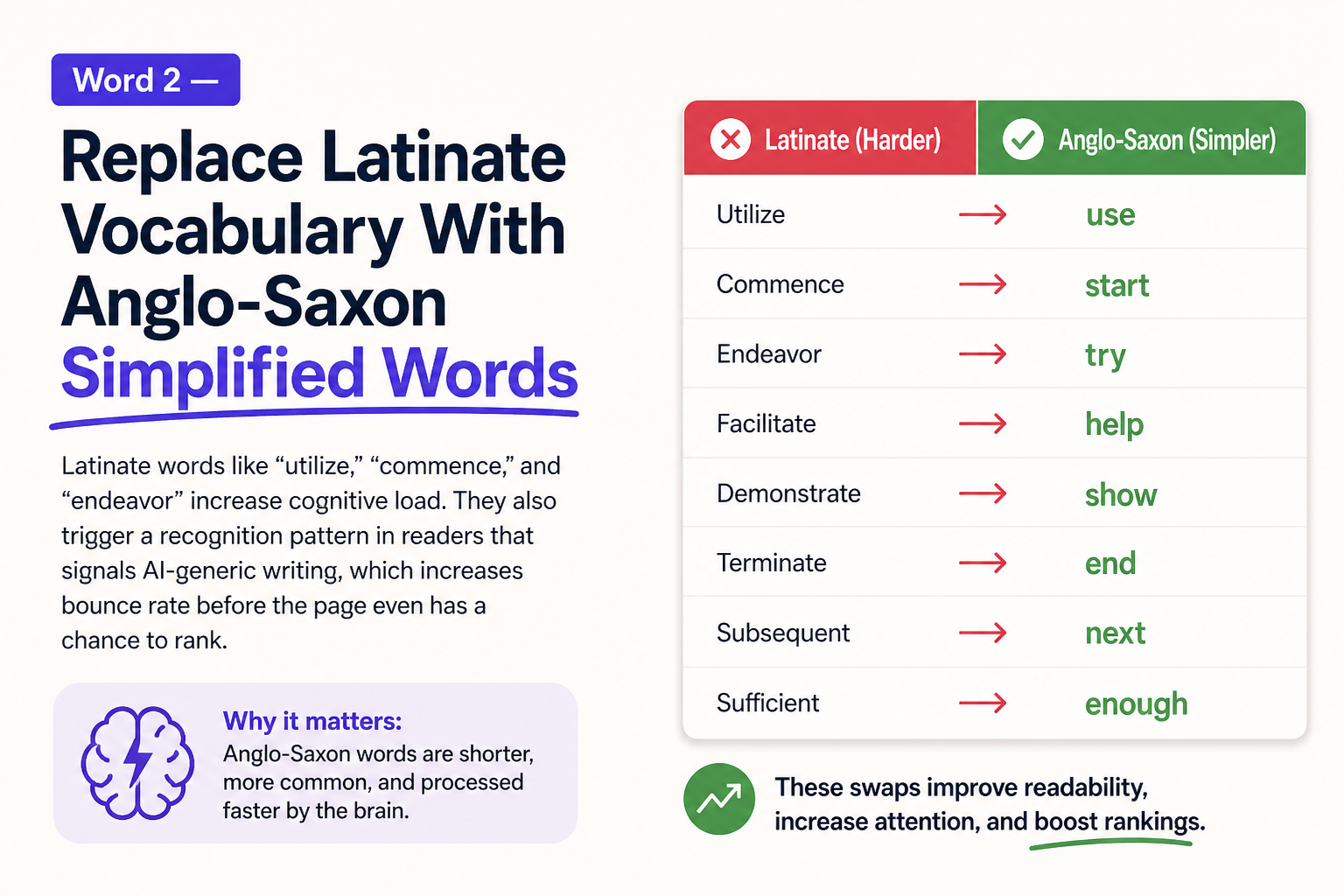
Word 2 — Replace Latinate Vocabulary With Anglo-Saxon Simplified Words
Latinate words like "utilize," "commence," and "endeavor" increase cognitive load. They also trigger a recognition pattern in readers that signals AI-generic writing, which increases bounce rate before the page even has a chance to rank.
Why Latinate Words Trigger AI-Slop Detection in Readers
Anglo-Saxon words are shorter, more common, and processed faster by the brain. Readers do not consciously notice the difference, but their behavior shows it. Pages written with plain Anglo-Saxon vocabulary hold attention longer. Content marketers on r/SEO have noted that pages written at a lower Flesch-Kincaid grade consistently outperform in featured snippet captures for informational queries. The simple english converter principle applies here: if a simpler word exists and carries the same meaning, use it.
The Anglo-Saxon Swap List: 8 Words to Change Before You Publish
Applying a word simplifier pass before publishing means checking for these specific offenders:
- Utilize, use
- Commence, start
- Endeavor, try
- Facilitate, help
- Demonstrate, show
- Terminate, end
- Subsequent, next
- Sufficient, enough
These swaps are not stylistic preferences. They are readability decisions that directly affect how long a reader stays on the page. The rephrase professionally instinct often defaults to Latinate vocabulary, which is the opposite of what ranks.
Word 3 — Use Precise Quantifiers Instead of Vague Intensifiers
Replacing "very important" with a specific claim is both a simplified word move and an E-E-A-T signal. Vague intensifiers are filler. Precise quantifiers are evidence.
How Vague Intensifiers Undermine E-E-A-T and Topical Authority
Words like "very," "extremely," "quite," and "somewhat" add syllables while reducing informational density. Google's quality evaluators and its NLP models recognize hedged, intensifier-heavy language as a signal of low expertise. Precise language, by contrast, signals that the author knows the specific answer, not just the general topic. Using an ai sentence helper to spot these patterns in draft content saves one complete editing pass.
Turning Vague Claims Into Rankable, Quotable Statements
Before: "This is very important for your SEO strategy."After: "This affects your featured snippet eligibility directly."
Before: "Passive voice makes content extremely complex to read."After: "Passive voice adds an average of four words per sentence."
Before: "This change is quite significant for rankings."After: "This change affects crawl budget allocation."
Each rewrite removes the intensifier, shrinks the sentence, and produces a statement that is quotable and verifiable. That is the profile of content Google extracts for direct answers.
If auditing every sentence for vague language sounds like a full-time job, Indexly's AI SEO agent handles this at the content-generation stage, scoring keyword opportunities, drafting SEO-optimized articles with precise language baked in, and publishing directly to your CMS. No manual editing pass required.
Word 4 — Activate Passive Constructions to Cut Word Count by Up to 30%
Passive voice is a word-count tax. Converting passive constructions to active voice is the fastest mechanical way to compress a paragraph without losing a single idea.
The Passive Voice Word-Count Tax on Your Content Budget
"The report was completed by the team" uses seven words. "The team completed the report" uses five. That is a 28% reduction per sentence. Across a full article, that compression shortens average sentence length, reduces paragraph density, and makes content faster to scan. The short sentences generator principle is simple: remove the actor, and you add words. Put the actor first, and the sentence compresses automatically.
A Three-Step Test: Is This Sentence Passive and Should It Be?
- Find the verb and ask: is it a form of "to be" plus a past participle?
- Ask: can you insert "by zombies" after the verb and have it make grammatical sense?
- If yes to both, rewrite the sentence so the actor comes first and the verb follows directly.
Apply this test to every paragraph before publishing. Most informational content passes this test on 20 to 40 percent of its sentences.
Word 5 — Choose Concrete Nouns Over Abstract Category Words for Snippet Wins
Abstract nouns like "solution," "approach," and "methodology" create comprehension drag. Google cannot extract a direct answer from a sentence built on abstractions because there is no specific referent to surface.
Why Abstract Nouns Hurt Snippet Eligibility
When a heading uses "solution" or "framework," Google has to guess what the content is actually about. Concrete nouns match search queries directly. A reader searching for "keyword gap analysis" does not type "competitive solution." Using a better sentence generator approach means naming the specific thing, not the category it belongs to.
Concrete Noun Substitutions for the 6 Most Overused SEO-Content Abstractions
|
Abstract SEO Noun |
Concrete Simplified Replacement |
|---|---|
|
Solution |
Tool, fix, script, template |
|
Approach |
Workflow, checklist, sequence |
|
Methodology |
Process, formula, audit |
|
Framework |
Structure, outline, map |
|
Strategy |
Plan, campaign, schedule |
|
Ecosystem |
Stack, platform set, toolchain |
Replacing abstractions in H2s and subheadings immediately improves the match between the heading and the search query. That match is one of the primary signals Google uses to select featured snippet content.
Word 6 — Front-Load Simplified Keywords in Headlines and First Sentences
Simplified word placement determines whether Google reads a sentence as a direct answer. Word choice matters. Position matters more.
The Front-Load Rule: Why Keyword Position Within a Sentence Matters
Rule: Place your simplified target keyword within the first five words of every H2 and the first sentence of every paragraph.
Google weights the beginning of headings and sentences more heavily when parsing content for relevance. A keyword buried at the end of a headline scores lower than the same keyword at the start. This is a structural SEO decision with direct impact on click-through rate and snippet capture rate. Ways to boost SEO with headline optimization start here, before any other on-page change.
Applying Front-Loading to H2s, Meta Descriptions, and Intro Sentences
Before: "How to improve your content so that it ranks for simplified word targets" After: "Simplified word targets: how to rank your content faster"
Before: "A guide to writing SEO headlines that capture featured snippets" After: "SEO headlines win featured snippets when the keyword leads"
Both rewrites move the primary keyword to the first five words. Both shorten the headline. Both increase the probability of a snippet capture without changing the underlying topic.
Word 7 — Use Simplified Transition Words to Signal Content Structure to Crawlers
Simplified words extend to the connective tissue of your content, not just nouns and verbs. Transition words are structural signals that help both readers and Googlebot parse content hierarchy.
How Transition Words Help Googlebot Parse Content Hierarchy
When a sentence begins with a bloated phrase like "In light of the foregoing," Googlebot has to parse four words before reaching the logical connector. When it begins with "So," the signal is immediate. Short transitions reduce parsing overhead and reduce pogo-sticking by helping readers follow the argument without re-reading. A sentence generator ai that front-loads clear transitions produces content that crawls and reads faster.
12 Simplified Transitions That Replace Bloated Connective Phrases
|
Bloated Phrase |
Simplified Transition |
|---|---|
|
In light of the foregoing |
So |
|
With respect to |
On |
|
Notwithstanding the above |
But |
|
As a consequence of |
Because |
|
In the event that |
If |
|
For the purpose of |
To |
|
It is worth noting that |
Note: |
|
In addition to the above |
Also |
|
At this point in time |
Now |
|
In order to |
To |
|
As previously mentioned |
Earlier |
|
On the other hand |
But |
Apply this list to your next draft before publishing. These twelve swaps alone reduce average sentence length and eliminate the hedging patterns that flag content as low-confidence to both readers and crawlers.
The Decision in Front of You
You now have two paths. You can manually audit every piece of content for simplified word choices before publishing. For one article, that is viable. For a content program producing ten or twenty articles a month, it becomes the bottleneck that limits your organic traffic growth.
The alternative is building simplification into the generation layer so every article ships already optimized. That is not a workflow shortcut. It is a compounding advantage. Every article that publishes with plain language, front-loaded keywords, concrete nouns, and active voice builds topical authority faster than a dense, over-engineered equivalent. Simplified language is not a writing style. It is a compounding SEO asset that every published article either builds or wastes.
See how Indexly identifies competitor keywords, generates simplified SEO-ready articles, and publishes them to your site automatically, no editing pass required. Start your first campaign free.
Frequently Asked Questions
What is a simplified word in SEO content writing?
A simplified word is a shorter, more common alternative to a complex term that carries the same meaning with less cognitive load. In SEO content writing, simplified words reduce reading grade level, improve dwell time, and increase the probability that Google selects the sentence as a featured snippet answer.
Does using simpler words hurt topical authority or E-E-A-T scores?
No. Topical authority comes from coverage depth, not vocabulary complexity. E-E-A-T scores reflect expertise, experience, and trust, all of which plain language demonstrates more clearly than jargon. Concrete, precise claims written simply score higher on both dimensions than hedged, Latinate-heavy copy.
How do I know if my content is too complex for Google to rank?
Run a Flesch-Kincaid grade level check on your draft. If the score is above Grade 10 for informational content, your sentence length or word complexity is likely creating friction. Check for nominalizations, passive constructions, vague intensifiers, and abstract nouns as the four most common causes.
Can an AI tool automatically simplify my content before publishing?
Yes. AI writing tools can apply simplification rules during the drafting stage, flagging nominalizations, passive constructions, and Latinate vocabulary before the content reaches an editor. The most efficient approach is building simplification into the generation layer rather than adding a manual editing pass after drafting.
What is the ideal reading grade level for content targeting SEO strategists?
Grade 8 to Grade 10 is the target range for technical content aimed at experienced readers like SEO strategists and content marketers. This level is direct and precise without being dense. It matches the reading speed of someone skimming for a specific answer, which is how most professionals consume content in this category.