Lead Generation Content Marketing: Formats, Funnels, and Metrics That Actually Convert
Discover which content formats drive leads at every funnel stage, how to measure what matters, and how AI can eliminate the manual work holding you back.


Most content marketing teams are producing more content than ever and generating fewer qualified leads. The problem is rarely effort. It is execution: manual keyword research that burns hours, generic AI output that reads like everyone else's blog, and a publishing workflow so slow that the momentum dies before the content goes live.
The right content type at the wrong funnel stage does not convert. Publishing without a measurement framework means optimizing for traffic instead of pipeline. Both mistakes are common, and both are fixable.
This article shows exactly which content formats work at each funnel stage, how to measure their lead impact, and how to stop doing the slow parts by hand.
What Lead Generation Content Marketing Actually Means (and Why Most Definitions Miss the Point)
Content marketing definition vs. lead generation content marketing definition
Most definitions of content marketing stop at awareness. They describe the practice of creating and distributing valuable content to attract an audience. That definition is accurate but incomplete for anyone trying to fill a pipeline.
Lead generation content marketing is: Content created with a specific next step built in, where each piece moves a reader from anonymous visitor to identified lead through a deliberate conversion mechanic, not just passive consumption.
The distinction matters because teams that treat content marketing as a brand awareness activity publish heavily and capture nothing.
The funnel contract: every piece of content must earn a next step
Every piece of content should earn a next step from the reader. That next step might be a form submission, a demo request, a content download, or a newsletter sign-up. If the content has no conversion path, it is brand content, not lead generation content.
The funnel contract is simple: content earns attention, the conversion mechanic captures it. Without both, you have a content program, not a lead engine.
Why b2b content marketing strategy fails when awareness and conversion content are treated the same
B2B content marketing strategy breaks down when a team publishes a thought leadership post and expects it to generate SQLs. Awareness content builds trust and captures search demand. Conversion content closes the identity gap between visitor and lead.
Treating them as interchangeable is why so many content programs show strong traffic numbers and flat lead volume. The fix is mapping every piece of content to a specific funnel stage before production starts, not after.
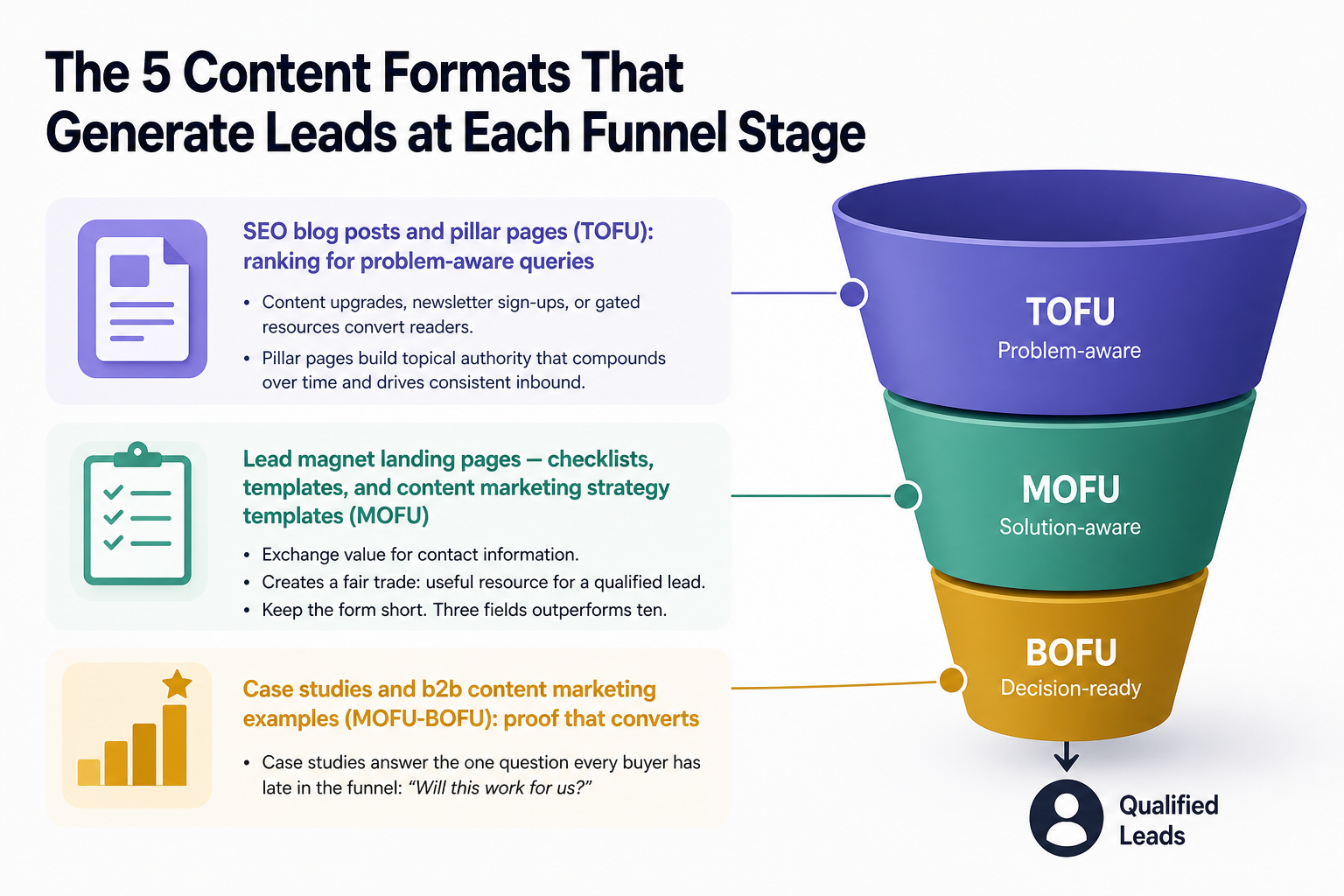
The 5 Content Formats That Generate Leads at Each Funnel Stage
Format choice is a production decision with direct revenue consequences. The wrong format for the funnel stage burns budget and earns no pipeline.
SEO blog posts and pillar pages (TOFU): ranking for problem-aware queries
SEO blog posts target readers who are searching for a problem, not a solution yet. The conversion mechanic at this stage is a content upgrade, newsletter sign-up, or gated resource embedded in the post. Without one, the post earns a pageview and nothing else.
Pillar pages take this further by clustering supporting articles around a central topic, building topical authority that compounds over time. SEO content marketing at this level is a long game, but it generates consistent inbound volume that paid channels cannot replicate without ongoing spend.
Lead magnet landing pages — checklists, templates, and content marketing strategy templates (MOFU)
At the middle of the funnel, readers know their problem and are evaluating solutions. A well-designed lead magnet landing page, offering a checklist, template, or content marketing strategy template, exchanges value for contact information.
The format works because it creates a fair trade. The reader gets a specific, useful resource. You get a qualified lead who has self-identified as interested in the problem you solve. Keep the form short. Three fields outperforms ten every time.
Case studies and b2b content marketing examples (MOFU-BOFU): proof that converts
Case studies answer the one question every B2B buyer has before committing: has this worked for someone like me? A strong case study names the problem, the approach, and the result in specific terms. Vague outcome language kills credibility.
Roy Harmon, CMO at LeadPost, frames the logic clearly: understanding your target market and identifying their pain points is the foundation, and from there you create solutions that speak directly to those needs. Case studies are that proof made visible. Harmon specifically points to webinars, case studies, and targeted content as the tactics that attract and nurture qualified leads.
The MOFU-BOFU position of case studies means they work best when a reader is already aware of your brand but has not committed. Gate them lightly or not at all. The content itself does the converting.
Webinars and video content — content video marketing for pipeline acceleration (MOFU)
Webinars combine education with a live sales interaction. Attendees self-select as highly interested, making them among the warmest leads a content program produces. The conversion mechanic is the registration form, and follow-up sequences can move registered attendees who did not attend into an email nurture track.
Short-form video content at this stage serves a different function: it builds familiarity and drives viewers toward deeper content. Content video marketing works best when it leads somewhere, a landing page, a longer video, or a sign-up flow.
Interactive tools and calculators (BOFU): the shortest path from curiosity to contact
Interactive tools and calculators convert because they make the value immediate and personal. A pricing calculator, an ROI estimator, or a self-assessment gives the reader a result tied to their specific situation. The conversion mechanic is the results delivery, often gated behind an email address.
At the bottom of the funnel, personalization shortens the path from curiosity to contact. A tool that shows a prospect exactly what they stand to gain removes the abstraction that stalls B2B purchase decisions.
Lead Generation Content Marketing Metrics: What to Measure at Each Stage
Traffic is not a lead generation metric. Teams that optimize for sessions and page views instead of pipeline signals spend months producing content that earns no revenue.
TOFU metrics: organic impressions, click-through rate, and scroll depth
Top-of-funnel content earns discovery. The metrics that matter here are organic impressions, click-through rate from search, and scroll depth as a proxy for content quality. A post with high impressions and low CTR has a headline problem, not a traffic problem.
Scroll depth tells you whether readers are engaging or bouncing after the first paragraph. If fewer than 40% of readers reach your in-content CTA, the content is not holding attention long enough to convert.
MOFU metrics: form conversion rate, cost per lead, and lead magnet download rate
Middle-of-funnel metrics measure how well content captures the interest it earns. Form conversion rate on landing pages, cost per lead from gated content, and lead magnet download rate are the three signals that show whether your content is earning identity, not just attention.
A form conversion rate below 10% on a content-driven landing page usually signals a mismatch between what the headline promises and what the page delivers.
BOFU metrics: sales-qualified lead (SQL) rate, pipeline influenced, and content-assisted revenue
Bottom-of-funnel metrics connect content directly to revenue. SQL rate measures what percentage of content-generated leads meet your qualification criteria. Pipeline influenced tracks which deals had a content interaction in the buying journey. Content-assisted revenue closes the loop between what you publish and what you earn.
These metrics require CRM integration and attribution modeling. Without them, content is treated as a cost center because no one can prove its revenue contribution.
The one dashboard view that connects content output to revenue
|
Stage |
Primary Metric |
North-Star KPI |
|---|---|---|
|
TOFU |
Organic impressions and CTR |
Branded search volume growth |
|
MOFU |
Form conversion rate |
Cost per qualified lead |
|
BOFU |
SQL rate |
Content-assisted pipeline revenue |
Generative AI and AI Overviews in 2026 are forcing content teams to rethink their north-star metrics. Zero-click answers mean a ranking position no longer guarantees a click. Teams shifting their TOFU north-star from keyword rankings to branded search volume and pipeline influence are measuring what actually matters: whether people seek out your brand specifically, not just stumble onto your content.
How to Build a Content Calendar That Maps Formats to Lead Goals
A content calendar built around publishing cadence instead of funnel intent produces volume without pipeline. The fix is not a new template. It is a new planning logic.
Auditing existing content by funnel stage before adding new pieces
Before commissioning new content, audit what you have. Categorize every published piece as TOFU, MOFU, or BOFU. Most teams discover they have 80% awareness content and almost nothing in the conversion stages. That ratio explains a flat lead volume more clearly than any analytics report.
Once you can see the gap, you stop adding to the problem by commissioning more awareness posts.
A 30-day content marketing calendar framework: TOFU, MOFU, BOFU ratio
A functional 30-day content marketing calendar follows a rough ratio: 50% TOFU, 30% MOFU, 20% BOFU. Each slot in the calendar should carry three pieces of information: the format, the funnel stage, and the named owner.
A named owner is not optional. A common failure in B2B lead generation is that marketing generates traffic but sales knows nothing about it. When the calendar assigns a named owner to each piece, whether content, demand gen, or sales, the lead handoff gap closes by default. The calendar becomes an organizational contract, not just a schedule.
Content pillars for social media and how they feed the lead funnel
Content pillars for social media organize your distribution into consistent themes that map to funnel stages. A B2B brand might run three pillars: educational posts that earn discovery (TOFU), customer story reposts that build credibility (MOFU), and direct product posts that drive action (BOFU).
Each pillar feeds a different part of the funnel. Running all three simultaneously means your social presence is doing pipeline work, not just building an audience.
Using content marketing automation to maintain cadence without adding headcount
Most teams lose calendar momentum because keyword research and writing create a planning bottleneck. Every new article requires research, competitive analysis, a brief, a draft, an edit, and a publish cycle. That sequence takes days, sometimes weeks, per piece.
This is exactly the gap Indexly was built to close. Its autoblogger tools identify which competitor keywords you are missing, scores each opportunity by revenue potential, and writes SEO-optimized articles with original data and infographics, then publishes them directly to your site. Your content calendar fills itself with intent-matched content instead of whatever topic a writer thought of this week.
The automation handles the planning bottleneck. Your team focuses on strategy, review, and the conversion mechanics that software cannot design for you.
Distribution Channels That Amplify Lead Generation Content Marketing ROI
Publishing without a distribution plan is the fastest way to earn zero leads from content that deserved to earn many. Pick two or three channels based on where your buyers actually spend time. Spreading budget across every platform produces thin results everywhere.
LinkedIn content marketing: why B2B lead gen lives or dies on LinkedIn
LinkedIn content marketing works for B2B lead generation because the platform's professional context means users are already in a work mindset. A post that earns engagement on LinkedIn reaches decision-makers who cannot be targeted as efficiently anywhere else.
Personalization multiplies the impact. Ben Lack, Founder and CEO of Interrupt Media, makes the case directly: personalization and relationship building improves the ROI of lead generation efforts. On LinkedIn, that means writing posts that speak to a specific role's pain, not a generic audience. LinkedIn's targeting on the paid side reinforces what organic content starts.
Content marketing newsletters and email nurture: owned distribution beats rented reach
A content marketing newsletter is the only distribution channel you fully own. Social reach is algorithmic and can disappear overnight. Email reach is direct and compounds as your list grows.
Email nurture sequences take this further by delivering the right content format at the right funnel stage automatically. A subscriber who downloaded a checklist enters a MOFU sequence. One who attended a webinar enters a BOFU sequence. The channel does not change. The content mapped to their stage does.
SEO and organic search: building content that earns branded searches, not just clicks
Organic search remains a primary source of inbound lead volume for content-driven businesses. The shift in 2026 is that AI Overviews are absorbing more informational queries without delivering a click. Content teams that depend entirely on ranking for generic keywords are finding their traffic share eroding.
The durable play is building content that generates branded searches. When your audience starts searching for your brand by name because your content built that familiarity, you have traffic that AI cannot zero-click away.
Short-form video and social media content marketing for top-of-funnel demand
Short-form video earns attention faster than any other format at the top of the funnel. Sharing content in videos, infographics, and other digestible formats is one of the most consistent ways to attract quality leads at the awareness stage.
The distribution logic is: video earns the view, the view earns the click, the click earns the lead. Short-form video that does not direct viewers anywhere is brand content. Short-form video with a clear next step is a lead generation asset.
The 4 Most Damaging Lead Generation Content Marketing Mistakes (and How to Fix Them)
Mistake 1: Publishing awareness content without a conversion path
A blog post without a lead capture mechanism is brand content, not a lead generation asset. The fix is simple: every published piece must include at least one conversion path, a content upgrade, a gated resource link, or a newsletter sign-up form.
Audit your existing TOFU content and add a conversion element to each piece. You will generate leads from content that is already ranking without publishing a single new article.
Mistake 2: Forms with too many fields and landing pages that do not match ad promise
A visitor arrives at your landing page with one question: is this relevant to me? If the page does not answer that within five seconds, they leave. If the form asks for twelve fields, most of them leave anyway.
The fix is a two-part edit: reduce form fields to the minimum needed to qualify the lead, and audit every landing page against the ad or link that drove traffic to it. The headline, offer, and visual must match what the reader expected before they clicked.
Mistake 3: No sales-marketing handoff — leads disappearing into a black hole
Marketing generates the lead. Sales never sees it. This is not a technology problem. It is an organizational one. There is no clear agreement about who follows up which lead, and no defined process for handing them off.
The fix is a named owner in the CRM for every content-generated lead, a follow-up SLA agreed between marketing and sales, and a weekly review of content-sourced pipeline. The calendar framework from the previous section creates the structure. The SLA enforces it.
Mistake 4: Treating AI-generated content as a finished product — and losing brand voice
AI-generated content that goes straight from prompt to publish reads like AI slop because it is. It lacks specific data, original perspective, and the brand voice signals that make readers trust the source.
The fix is treating AI output as a draft, not a deliverable. Add original data points, real examples, and brand-specific framing before publishing. Content that includes original research and specific visual assets like infographics earns links, builds authority, and converts readers who would otherwise bounce from a generic post.
Conclusion
You now have the framework: five formats mapped to funnel stages, three to four metrics per stage, a 30-day calendar logic, and four mistakes with fixes you can implement this week. The only remaining question is whether you rebuild this process manually or automate it.
Manual means a well-staffed team, months of ramp-up, ongoing keyword research cycles, and a constant battle to maintain publishing cadence. Automated means compressing all of that into a system that identifies opportunities, writes the content, and publishes it continuously without requiring a research session every time.
See how Indexly identifies your highest-opportunity keywords, writes the content, and publishes it automatically, without a single manual research session. Start your first automated article free.
Frequently Asked Questions
What is lead generation content marketing?
Lead generation content marketing is the practice of creating content that captures reader identity through deliberate conversion mechanics, not just building awareness. Each piece has a next step built in. It moves a reader from anonymous visitor to identified lead through forms, gated resources, or direct offers tied to their funnel stage.
Which content format generates the most B2B leads?
Case studies and gated lead magnets generate the most qualified B2B leads because they attract readers who are already evaluating solutions. Webinars produce the warmest leads because registration signals high intent. The right answer depends on your funnel stage. No single format dominates every stage.
How do I measure the ROI of content marketing for lead generation?
Measure content-assisted pipeline revenue and SQL rate from content-sourced leads. These connect published content to deals in your CRM. Traffic and impressions do not measure ROI. Attribution modeling, even a simple first-touch or last-touch model in your CRM, is required to make the connection visible.
What is a content marketing strategy and how does it differ from a lead generation strategy?
A content marketing strategy defines what content to create, for whom, and through which channels. A lead generation strategy defines how to convert audience attention into captured leads. Lead generation content marketing combines both. A content strategy without lead generation mechanics produces an audience. A lead generation strategy without content produces interruptions.
How often should I publish content to consistently generate leads?
Publishing frequency matters less than funnel coverage. One well-optimized piece per funnel stage per week outperforms daily publishing with no conversion paths. Audit for gaps first. Fill MOFU and BOFU before adding more TOFU volume.
Can AI tools replace a content marketing agency for lead generation?
AI tools handle research, drafting, and publishing at a speed no agency can match. What they cannot replace is strategic judgment, original research, and conversion architecture. The better question is whether you need an agency's overhead when AI handles the production volume and your team handles the strategy.