How to Be a Prompt Writer: Skills, Steps, and Tools That Actually Work
Learn how to become a prompt writer in 2026. Master the skills, frameworks, and AI tools that turn vague inputs into high-quality outputs every time.

Everyone is using AI. Most of the outputs are generic because the prompts behind them are lazy. The gap between AI content that converts and AI slop is not creativity. It is structure. A vague prompt like "write me a social media post" produces mush. A specific prompt with a defined audience, format, and constraint produces something you can actually publish. As a prompt writer, your job is to close that gap. This guide covers the exact skills, a four-step framework, and the tools that make the difference between AI content that works and content that needs to be rewritten three times before it is usable.
What Is a Prompt Writer and Why the Role Matters Now
Most content marketers already write prompts every day without calling it that. Every instruction you give an AI tool is a prompt. The question is whether those instructions are structured well enough to produce useful output consistently.
Prompt Writer vs. Prompt Engineer: What Is the Difference
Prompt engineering is developer-facing work. It involves building system prompts, optimizing AI pipelines, and integrating models into products. Prompt writing is content-facing. It means crafting the inputs that produce specific written outputs: emails, articles, social media content, SEO headlines, and more. The skill set overlaps, but the context is completely different.
A prompt writer is someone who crafts structured instructions for AI tools to produce specific, usable written content. The role sits at the intersection of editorial judgment and AI behavior, requiring clarity about the task, audience, format, and constraints before a single word is generated.
This distinction matters for SEO strategists and content marketers because the sentence generator ai tools they use daily require precise input to deliver precise output. A prompt writer generator mindset means treating every AI interaction as a repeatable workflow, not a one-off experiment.
What a Prompt Writer Actually Produces
A prompt writer produces the instructions that generate drafts, not the final content itself. The output includes structured prompt templates for recurring tasks, iteration logs that document what worked and what failed, and prompt libraries organized by content type. For a growth team running automated social media marketing or scaling email marketing for lead generation, a well-built prompt library is an asset that compounds over time.
The Core Skills Every Prompt Writer Needs
Bad AI output is almost always a prompt problem. Before blaming the model, audit the input. These four skills cover the most common failure points.
Clarity and Specificity: The Foundation of Every Good Prompt
Vague prompts return vague answers. A prompt asking an AI to "explain a topic" gives the model no constraints to work against. A prompt that specifies the focus, the audience, and the scope forces the model to narrow down. The difference between "tell me about email marketing for lead generation" and "write a three-sentence summary of email list segmentation for B2B SaaS marketers" is the difference between a generic paragraph and a usable draft. Specificity is not optional. It is the skill.
Tone Detection and Audience Framing
The same content brief written for two different audiences produces two completely different articles. Tone detection means knowing whether the output should rephrase professionally, simplify wording for a general audience, or match a technical register for a specialist. Before writing any prompt, define who is reading the output and what they already know. A writing simplifier instruction works for a consumer-facing blog. It fails for a B2B product page.
Constraint Setting: Length, Format, and Voice
Format constraints are the most commonly skipped step. Telling an AI to "make sentence simple" or "make it shorter" after the fact wastes time. Build length, format, and tone into the original prompt. A sentence compressor instruction tacked onto a bad prompt still returns a short, bad paragraph. A prompt that specifies "three bullet points, each under 15 words, written for a marketing manager" removes the ambiguity before it creates problems.
Iteration and Troubleshooting Weak Outputs
When an output misses the mark, the fix is diagnostic, not creative. Ask what the prompt failed to specify. Common failure modes: the task was undefined, the audience was missing, the format was left open, or the constraints contradicted each other. A simple english converter instruction on a technical piece fails because the constraint conflicts with the audience expectation. Iteration is structured problem-solving, not guessing.
Weak Prompt vs. Strong Prompt: Marketing Examples
|
Use Case |
Weak Prompt |
Strong Prompt |
|---|---|---|
|
Email response |
Write a reply to a customer complaint |
Write a 3-sentence professional reply to a late delivery complaint. Apologize, give a reason, offer a resolution. |
|
Social media content |
Write a LinkedIn post about our product |
Write a 60-word LinkedIn post for SaaS marketers. Lead with a pain point. End with one question. No hashtags. |
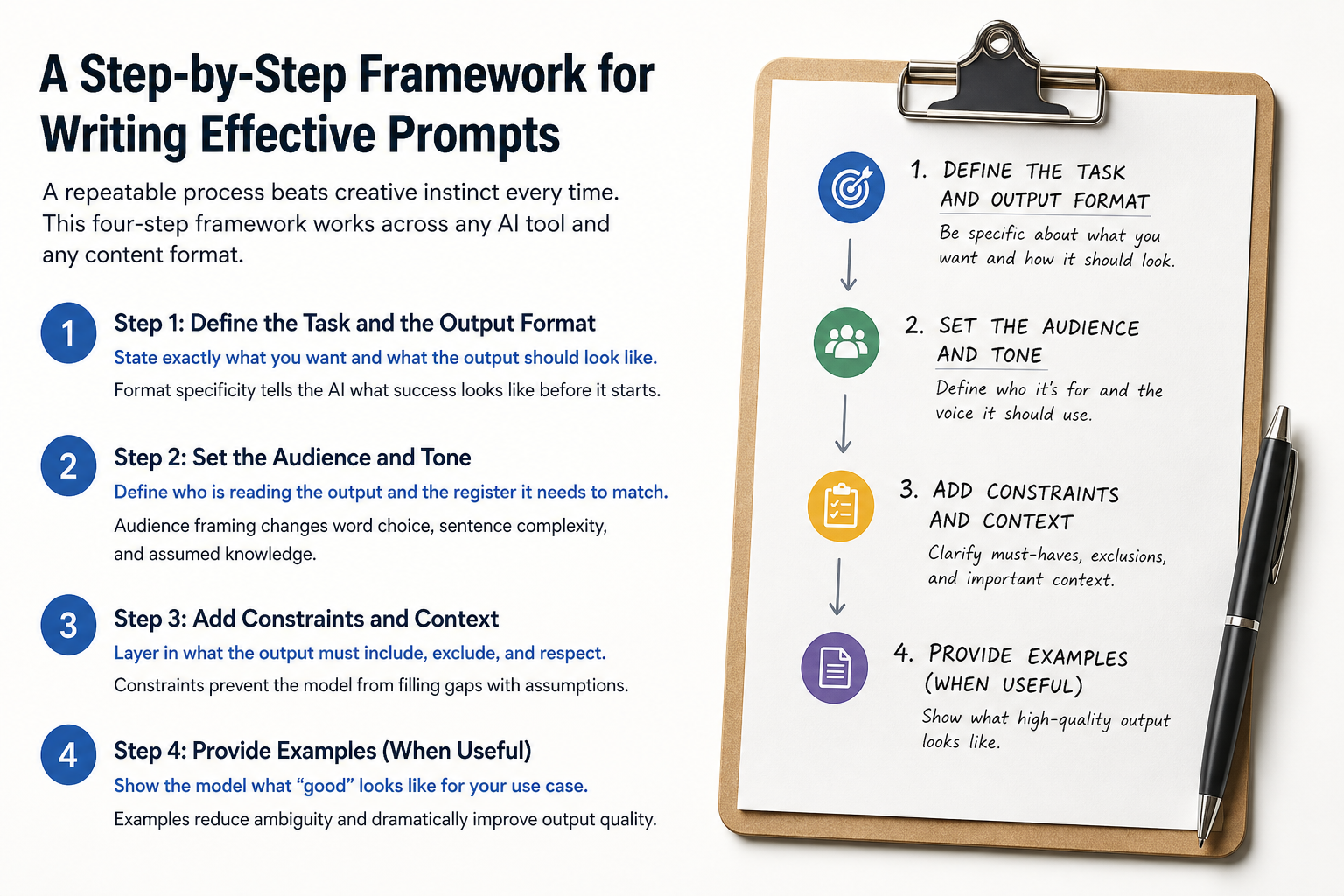
A Step-by-Step Framework for Writing Effective Prompts
A repeatable process beats creative instinct every time. This four-step framework works across any AI tool and any content format.
Step 1: Define the Task and the Output Format
State exactly what you want and what the output should look like.
The task is not "write something about X." The task is "generate five SEO headlines for a blog post targeting the keyword 'email marketing for franchises,' each under 65 characters." Format specificity tells the ai sentence generator free what success looks like before it starts. One concrete example: "Write a 200-word product description for a B2B SaaS tool. Use short sentences. No bullet points."
Step 2: Set the Audience and Tone
Define who is reading the output and the register it needs to match.
Audience framing changes word choice, sentence complexity, and assumed knowledge. A prompt for a sentence generator ai producing content for beginners needs different framing than one targeting growth marketers. Be explicit: "Write for a marketing manager who understands paid search but has never run an SEO campaign." One example: "Tone: direct and confident. Avoid jargon. Write as if the reader has 30 seconds."
Step 3: Add Constraints and Context
Layer in what the output must include, exclude, and respect.
Constraints prevent the model from filling gaps with assumptions. Clear, detailed prompts produce more accurate outputs. Effective prompts should clearly state the task, define the intended audience, specify the format and tone, and include any constraints or assumptions relevant to the task. One concrete example: "Under 150 words. No passive voice. Include one stat if available. Do not mention competitor names."
Step 4: Test, Diagnose, and Refine
Run the prompt, read the output against your brief, and identify exactly what failed.
Refinement is not rewriting from scratch. It is adding one missing constraint at a time. If the ai sentence helper returns content that is too long, add a word count. If the tone is wrong, restate the audience. One example: if a better sentence generator produces flat copy for a social media content brief, the fix is usually adding a specific pain point the post should address, not changing the entire prompt.
Prompt Writer Tools: What to Use and When
Tool overload is real. The fix is matching the tool to the task, not building a stack of five AI platforms that do the same thing.
Free AI Text Editors for Drafting and Testing Prompts
ChatGPT (free tier): Primary use is testing and iterating prompts in a free ai text editor environment. Requires manual prompt iteration for every output.
Claude (free tier): Strong for longer-form content and nuanced tone matching. Requires manual iteration. Better for paragraph generator ai tasks where voice consistency matters.
Google Gemini (free): Useful for research-adjacent prompts and ai free paragraph generator tasks. Manual iteration required.
Specialized Generators: Email, Paragraphs, and Social Content
Jasper: Built for marketing teams running content operations. Handles email writer ai tasks and social media content workflows. Partially automated with templates but still requires prompt input per task.
Copy.ai: Covers specialized generators for email, paragraph writer generator free tasks, and ad copy. Manual prompt iteration per output, but templates reduce setup time.
When Automated Prompt Optimization Replaces Manual Writing
The concept of the prompt writer is shifting. You no longer give a thousand-word instruction. You give a high-level goal, and the system breaks it down, uses tools, and self-corrects. The prompt is the starting point, not the entire process. This is the agentic shift, and it changes which tools belong in a content operation.
For SEO content production specifically, manual prompt writing for every article is a bottleneck that does not scale. Indexly removes that bottleneck entirely. Instead of writing and testing prompts for every keyword, Indexly's AI SEO agent identifies competitor keyword gaps, scores opportunities by search volume and keyword difficulty, generates SEO-optimized articles with original data and infographics matched to your brand voice, and publishes directly to your CMS. If prompt writing is a skill worth building, knowing when to automate it is the skill multiplier.
Common Prompt Writing Mistakes That Kill Output Quality
The most expensive AI mistakes in content marketing are invisible until the content is already half-published.
Being Too Vague: The Number One Prompt Killer
The mistake: Prompts without a defined task, audience, or format. The fix: before submitting any prompt, check that it answers three questions: what is the output, who is it for, and what format does it need to match. "Write about social media marketing for beginners" fails all three. "Write a 200-word intro paragraph for a beginner's guide to using social media for marketing, targeting small business owners with no prior experience" passes all three.
Skipping Format and Length Constraints
The mistake: Relying on the AI to choose length and structure. The fix: every prompt should include a word count or sentence count, a format specification (bullet list, paragraph, numbered steps), and any hard exclusions. A shortener ai instruction after the fact is inefficient. A sentence compressor step is wasted effort when a constraint at the start would have prevented the bloat. Build the constraint in before you generate.
Forgetting to Validate AI Output Before Publishing
The mistake: Treating AI output as final copy. The fix: always review AI-generated content for brand voice accuracy and factual claims before publishing. AI outputs should inform editorial judgment, not replace it. This applies directly to marketing teams using ai peer review workflows or auto blogger pipelines. The model does not know your brand, your legal constraints, or your audience's specific sensitivities. You do.
Is Manual Prompt Writing Still Worth Learning in 2026?
Take an honest position: manual prompt writing is a foundation skill. It is not a career destination.
What Automation Can and Cannot Replace
Automated frameworks now write and optimize prompt instructions based on data, not human intuition. Letting a human manually tweak a prompt when an onboard system can do it better is inefficient by design. For repeatable content production tasks, including SEO articles, email sequences, and social media content, automation produces more consistent output faster than manual iteration. The llmo and profound answer engine optimization categories are already moving toward agentic workflows where the prompt is handled by the system, not the writer.
What automation cannot replace is the upstream decision-making. Knowing what content to create, which audience to target, and what the brand actually sounds like requires human judgment. A ghost writer ai or ai ghost writer tool can execute a well-defined brief. It cannot define the brief for you.
The Prompt Writer Skills That Remain Human Advantages
Audience empathy, editorial instinct, and brand voice judgment are not automatable. A simpler ai system can produce grammatically correct output. It cannot decide whether that output matches the specific tone a B2B brand uses with enterprise buyers versus startups. The prompt writer skills worth investing in are the ones that feed better briefs into automated systems, not the ones that replace those systems with manual work.
The Fork in the Road
You now have a clear picture of what prompt writing is, how to do it, and where it breaks down. The practical question is how you want to spend your time.
If you are writing one-off prompts for creative briefs, exploratory research, or custom content, build the manual skill. The four-step framework in this article gives you a repeatable process that works across any AI tool. If you are running a content operation that needs to scale organic traffic, manual prompt iteration is a ceiling, not a workflow. Every hour spent testing prompts for SEO articles is an hour not spent on strategy, distribution, or analysis.
See how Indexly automates SEO content from keyword discovery to published article, no prompt writing required.
Frequently Asked Questions
What does a prompt writer do?
A prompt writer crafts structured instructions for AI tools to produce specific written outputs. The role involves defining the task, audience, format, and constraints for every AI interaction, then iterating on those inputs until the output meets editorial standards. Prompt writing sits between editorial strategy and AI execution.
Do I need coding skills to become a prompt writer?
No coding skills are required for content-facing prompt writing. The role relies on editorial clarity, audience understanding, and structured thinking, not technical development. Prompt engineering for AI product development is different and does require programming knowledge.
What is the difference between a prompt writer and a copywriter?
A copywriter produces final content directly. A prompt writer produces the instructions that generate draft content through AI tools. The skill sets overlap in areas like audience framing and tone matching, but a prompt writer focuses on structuring inputs rather than crafting outputs sentence by sentence.
How long should a good prompt be?
Length is determined by complexity, not by a fixed word count. A simple sentence generator free task needs three to five lines covering the task, audience, and format. A complex article brief needs ten to fifteen lines covering tone, constraints, structure, and examples. Longer prompts are only better if the additional detail removes ambiguity. Extra words that repeat or hedge add noise.
Can prompt writing be automated?
Yes, for repeatable content production tasks. Agentic AI systems now accept high-level goals and generate their own internal instructions to complete complex workflows. Manual prompt writing remains useful for exploratory, one-off, or highly customized tasks where the output requirements are not yet defined. For scaled content operations, automation produces more consistent results than manual iteration.